Light sensors or photosensors, which are designed to measure light intensity, are one of the most commonly used sensors in electronic applications. Light intensity is one of the seven base physical quantities. The measurement of light intensity is useful in many consumer, industrial, and security applications.
What is a light sensor?
A light sensor is a photoelectric device that converts light energy into electrical energy. These sensors are designed to be sensitive to visible, infrared, or ultraviolet light, which means they’re sensitive to a narrow band of the electromagnetic spectrum.
Light sensors are built from selective materials that generate electricity on exposure to a specific part of the spectrum. The amount of electricity is proportional to the intensity of the incident light.
Units of light intensity
Light intensity is one of the seven base physical quantities. Its “SI” unit is candela. One candela is the luminous intensity in a given direction of a source, which emits monochromatic green light of 540×1012 hertz and has a radiant intensity of 1/683 Watt per steradian in the same direction.
Candela is often used to indicate the intensity of artificial lights. Other units include lumen and lux. Lumen is the unit of luminous flux and measures the total amount of light emitted by a source. It’s defined as the amount of light emitted per second over a solid angle of one steradian from one candela’s uniform source. Lumen is often used to indicate the brightness of light sources.
While lumen is a unit used to express the total amount of light from a source, lux is the total amount of light from a source incident on a particular surface area. One lux is equal to one lumen of the light incident per square meter.
Types of light sensors
Light sensors are mostly passive devices. They’re categorized into two classes:
1. Generates electricity on exposure to light (i.e., photoemissive and photovoltaic devices)
2. Conducts electricity on exposure to light (i.e., photoconductive/photoresistive and photojunction devices)
One of the best examples of a photovoltaic device is a solar cell. A phototube is a photoemissive device. A light-dependent resistor is a photoconductive/photoresistive device. Photodiode and phototransistor are popular photojunction devices. However, it’s important to note the differences between these mechanisms.
Photoemissive devices are built from photosensitive materials, such as cesium, which generates free electrons on exposure to photons. These devices generate current when exposed to light. The higher the frequency of incident light, the greater the energy of the incident photons, and the higher is the amount of electric current generated.
In photovoltaic devices, the difference between two semiconductor materials is generated in response to incident light energy. Due to these potential differences, the current flows between the two semiconductor layers.
Photoconductive devices are built of semiconductor materials that are conductivity changes based on exposure to light. Due to the energy absorbed from the incident light, more free electrons are generated and the conductivity of such materials increases. The most common photoconductive material used in LDR cells is cadmium sulfide.
Photojunction devices are built from typical semiconductor materials, such as silicon or germanium. They operate like any normal diode or transistor except that their PN-junction is exposed to light and conduct when subject to light. The response of a photodiode or phototransistor is tuned to a specific range of the electromagnetic spectrum.
LDRs
A light-dependent resistor (LDR) or photoresistor is made of a photosensitive semiconductor that’s conductivity changes when exposed to the light.
 The material’s resistance is in several thousand ohms or mega ohms in the dark and falls to a few hundred ohms when subject to light. The semiconductor material is often laid in a zigzag pattern over a ceramic substrate to increase the dark resistance.
The semiconductor materials typically used for constructing photoresistors are lead sulfide (PbS), indium antimonide (InSb), lead selenide (PbSe), and cadmium sulfide (CdS).
Cadmium sulfide is the most common material used in the construction of LDRs. It’s a low-cost semiconductor with a response curve that closely matches that of the human eye. The peak sensitivity wavelength of cadmium sulfide is 560 nm to 600 nm.
Generally, LDR is used for the detection of light or dark. It can be connected in a voltage divider network with a transistor circuit or a microcontroller/microprocessor. It can also be connected to a Wheatstone Bridge with an operational amplifier circuit.
Photodiodes
A photodiode is a photojunction device. It’s a normal diode with its PN junction exposed to light through a transparent case or a clear lens. These diodes have the same voltage-current characteristics as any other junction diodes. But they have higher conductivity than conventional diodes because their junction is open to light exposure.
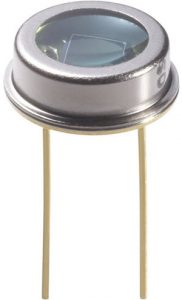 The photodiodes are connected in a revers-bias configuration, which conducts a reverse leakage current in the dark. When the photodiode is subject to light, the reverse leakage current is increased multiple times.
The reverse leakage current of a silicon diode in the dark is 1 uA. That of a germanium diode is 10 uA. On exposure to light, the reverse leakage current can shoot as high as 300 uA. The higher the intensity of incident light, the higher goes the reverse leakage current.
LDRs or photoresistors have a long response time. They may take several seconds to change conductivity after exposure to light. Photodiodes, on the other hand, have an instant response.
Although an LDR is tuned to the visible spectrum of light, photodiodes are sensitive to both visible and infra-red lights. The biggest disadvantage of photodiodes is that their reverse leakage current is still in the micro-ampere range – even when subject to light. Therefore, they require an operational amplifier circuit for light detection.
Photodiodes have a response time in nanoseconds. These are used in sophisticated applications including cameras, imaging and scanning devices, CD and DVD readers, optical fiber communication, motion detection, and positioning sensors.
Phototransistors
Phototransistors are similar to photodiodes except they provide amplification to the current. These are generally designed using normal NPN transistors with their collector-base PN junction exposed to light via a transparent case or a clear lens. Due to current amplification, their output current is 50 to 100 times greater than photodiodes. The base region is electrically isolated or has control for sensitivity.
As phototransistor already provides current amplification, unlike a photodiode, and requires no external amplifier for its operation. A phototransistor is simply a typical transistor with a base-collector exposed to light.
 The NPN phototransistors are connected in a circuit with their base-collector in a reverse-bias configuration. In the dark, there’s a small leakage current from the emitter. When exposed to light, the base current increases and is amplified by the transistor. The sensitivity of a phototransistor depends on the DC gain of the transistor. The output current can be controlled by the resistance between the base and the emitter of the phototransistor.
For higher sensitivity applications, such as optocouplers, Darlington phototransistors are used. In Photodarlington transistors, two NPN-type phototransistors are connected as a Darlington pair. The output current amplification is the product of the current amplification of the two phototransistors. Photodarlington transistors have a longer response time compared to phototransistors but offer higher sensitivity.
The phototransistors are typically used as optical switches, optical isolators, or infrared filters, and in IR remotes and optical-fiber communication.
Solar cells
Solar cells or photovoltaic cells are not sensors. They’re mainly used for generating solar energy and are made of single-crystal silicon PN junctions, similar photodiodes but with a broader response curve.
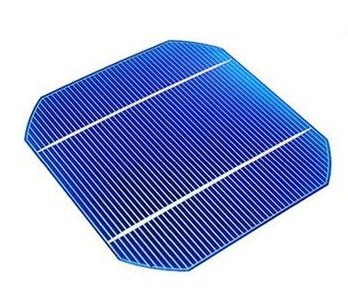 Unlike photodiodes connected in a reverse-bias configuration, solar cells are connected in a forward-bias configuration much like typical diodes. These cells are designed to be sensitive to sunlight instead of a narrow range of the electromagnetic spectrum. When exposed to solar radiation, a cell generates a potential difference of 0.58V.
Typically, several solar cells are connected in series in a panel to output a greater voltage. This DC voltage can drive a resistive load or be converted to AC for transmission.
Applications of light sensors
LDRs, photodiodes, and phototransistors are commonly used as light sensors in a variety of applications. Examples include: brightness adjustment in mobile devices, automatic lights, automatic irrigation, optical isolation, fiber optic communication, motion detection, IR remotes, position sensing, optical data, and optical imaging.
Light sensors are also used for security applications and home automation. For example, they’re often used in shipment cargo to detect at what times the container was opened to track lost goods. Some light sensors are also used for motion detection in many smart home security applications.
You may also like:




Filed Under: Featured Contributions, Sensors, Tutorials
Questions related to this article?
👉Ask and discuss on EDAboard.com and Electro-Tech-Online.com forums.
Tell Us What You Think!!
You must be logged in to post a comment.