Engineers Garage

  • Electronic Projects & Tutorials
    • Electronic Projects
      • Arduino Projects
      • AVR
      • Raspberry pi
      • ESP8266
      • BeagleBone
      • 8051 Microcontroller
      • ARM
      • PIC Microcontroller
      • STM32
    • Tutorials
      • Audio Electronics
      • Battery Management
      • Brainwave
      • Electric Vehicles
      • EMI/EMC/RFI
      • Hardware Filters
      • IoT tutorials
      • Power Tutorials
      • Python
      • Sensors
      • USB
      • VHDL
    • Circuit Design
    • Project Videos
    • Components
  • Articles
    • Tech Articles
    • Insight
    • Invention Stories
    • How to
    • What Is
  • News
    • Electronic Product News
    • Business News
    • Company/Start-up News
    • DIY Reviews
    • Guest Post
  • Forums
    • EDABoard.com
    • Electro-Tech-Online
    • EG Forum Archive
  • DigiKey Store
    • Cables, Wires
    • Connectors, Interconnect
    • Discrete
    • Electromechanical
    • Embedded Computers
    • Enclosures, Hardware, Office
    • Integrated Circuits (ICs)
    • Isolators
    • LED/Optoelectronics
    • Passive
    • Power, Circuit Protection
    • Programmers
    • RF, Wireless
    • Semiconductors
    • Sensors, Transducers
    • Test Products
    • Tools
  • Learn
    • eBooks/Tech Tips
    • Design Guides
    • Learning Center
    • Tech Toolboxes
    • Webinars & Digital Events
  • Resources
    • Digital Issues
    • EE Training Days
    • LEAP Awards
    • Podcasts
    • Webinars / Digital Events
    • White Papers
    • Engineering Diversity & Inclusion
    • DesignFast
  • Guest Post Guidelines
  • Advertise
  • Subscribe

The Four Incredible Science Experiments You Can Do With Your Phone

By Engineers Garage August 31, 2018

You definitely think that the phone you are carrying in your pocket is a feature loaded gadget that allows you not just to make calls, but to play games, watch videos, listen to music, make video chats, and download innumerable apps that further enhances its functionality.

But how you would feel if I tell you that you can actually do some really cool science experiments with your phone? Sure, you would be amazed!

Your smartphone is not just a device to fun, entertainment, and communication, but a mobile mini-computer that lets you do stuff, which you might have not even thought. It is almost like a computer and a data collector. While some phones are limitedonly to make phone calls, the modern smartphones allow their users to perform various science experiments as well.

Want to know about such science experiments that you can do with your phone? This post is going to tell you the same!

If your smartphone incorporates those sensors, then let me tell that you can do three fun experiments with it. These experiments would work on most of the smartphones and would work amazingly if you can probably use varieties of apps to gather the data. Also, doing these experiments is free!

So, let’s get started!

Bouncing Ball

Though the size of the ball does not matter, it would be better if you pick a small sized ball. To ensure that the experiment runs successfully, the ball must bounce and at the same time must make some noise.

The bouncing ball must bounce,and it must make a noise when it hits any surface. Now, the next step is to download the ‘phyphox’ app and open its experiment file. Place your smartphone close to the location that the ball will hit the surface. This will allow the microphone to pick the sound. The next step is to drop the ball and start recording the sound.

While the app records the sound all the times, you can enjoy throwing it on different surfaces. This app uses the time between bounces to estimate the bounce height, assuming that you are throwing the ball from the Earth’s surface with a vertical acceleration. Once the data is collected, you can explore the relationship between the initial drop distances and bounce height for a range of balls. You can measure the successive bounce changes, the height, and energy taken by the ball during each throw.

Measure the Speed of Sound
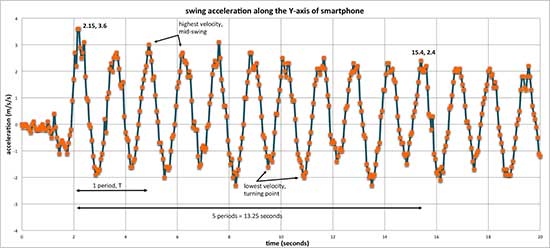
You must be having your own method to determine the speed of sound; this one will let you know the method to measure the sound’s speed via your phone. You need to have an app that can function as an acoustic stopwatch so that it can start and stop on the bases of sound noise.

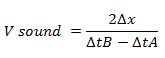
Now, you need two phones to perform this experiment. Keep the two phones at a distance apart so that both the phones are able to hear the same sound. While you will play a sound close to the first phone, the next phone will definitely listen to it a little late and vice versa. It is because of the difference that the sound takes to travel to each of the devices. Now for calculation, the speed of sound will be twice the measured distance between the two devices divided by the difference in time intervals.

So, here goes the equation,
Identify the Height of the Building
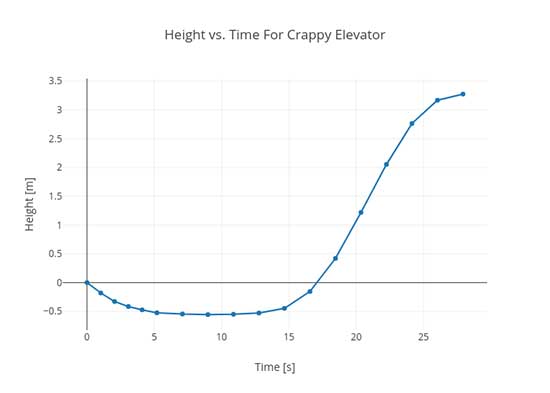
While the previous two experiments using a microphone, there is still one experiment that can be performed with the barometer that measures the atmospheric pressure. Yes, if you are using a modern-day phone, then it would have a sensor. The sensor is usefulnot just to use GPS to get the location, but it can also be used for more high-end functionality.

With the barometer in there, it is possible to measure the change in pressure or while taking a ride in an elevator. You can again use the phyphox app as it allows you to record the change in pressure and even allows you to calculate the height as a function of time. Additionally, you can record data from the accelerometer to measure the velocity as a function of time.

This way, you can know the height of every building you move through. Even the position-time data can be used to estimate the elevator velocity and compare it to the velocity from the acceleration data. Probably, they would not offer you the same results, but it is still great fun.

Predict Upcoming Earthquake
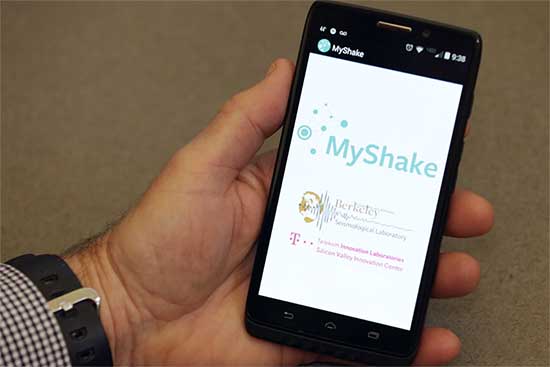
Every smartphone incorporates an accelerometer that is being used to determine seismic disturbances. This helps to predict an upcoming earthquake as well as enable individuals to evacuate the space in danger easily and in time. You can download the ‘MyShake’ app and let it run in the background in your smartphone. The mini-computer within your smartphone will then differentiate between real movements and normal seismic disturbances and ultimately define conclusions.

This way, it is possible to use your smartphone frequently for science in Earth observations. You can collect data about the Earth’s chemical, physical, and biological systems. The sensors in phones are ideal for making measurements near the surface of ground, things that can be conveniently misses due to obstructions like clouds, trees, or low vegetation, or because they are small.

You must be wondering that are there any more experiments that you can perform with your phone? And the answer is yes, there are! But for now, you must proceed to perform these experiments as they are enough to get started for now.

Just try these experiments,and sure you will love exploring these amazing used of your smartphone!


Filed Under: Tech Articles


Next Article

← Previous Article
Next Article →

Questions related to this article?
👉Ask and discuss on EDAboard.com and Electro-Tech-Online.com forums.


Tell Us What You Think!! Cancel reply

You must be logged in to post a comment.

EE TECH TOOLBOX

“ee
Tech Toolbox: Internet of Things
Explore practical strategies for minimizing attack surfaces, managing memory efficiently, and securing firmware. Download now to ensure your IoT implementations remain secure, efficient, and future-ready.

EE Learning Center

EE Learning Center
“engineers
EXPAND YOUR KNOWLEDGE AND STAY CONNECTED
Get the latest info on technologies, tools and strategies for EE professionals.

HAVE A QUESTION?

Have a technical question about an article or other engineering questions? Check out our engineering forums EDABoard.com and Electro-Tech-Online.com where you can get those questions asked and answered by your peers!


RSS EDABOARD.com Discussions

  • Voltage mode pushpull is a nonsense SMPS?
  • Input impedance matching network
  • High Side current sensing
  • The comparison of different Tcl script checkers
  • Reducing "shoot-through" in offline Full Bridge SMPS?

RSS Electro-Tech-Online.com Discussions

  • Is AI making embedded software developers more productive?
  • Back to the old BASIC days
  • Parts required for a personal project
  • PIC KIT 3 not able to program dsPIC
  • Failure of polypropylene motor-run capacitors

Featured – RPi Python Programming (27 Part)

  • RPi Python Programming 21: The SIM900A AT commands
  • RPi Python Programming 22: Calls & SMS using a SIM900A GSM-GPRS modem
  • RPi Python Programming 23: Interfacing a NEO-6MV2 GPS module with Raspberry Pi
  • RPi Python Programming 24: I2C explained
  • RPi Python Programming 25 – Synchronous serial communication in Raspberry Pi using I2C protocol
  • RPi Python Programming 26 – Interfacing ADXL345 accelerometer sensor with Raspberry Pi

Recent Articles

  • What is AWS IoT Core and when should you use it?
  • AC-DC power supply extends voltage range to 800 V DC
  • Infineon’s inductive sensor integrates coil system driver, signal conditioning circuits and DSP
  • Arm Cortex-M23 MCU delivers 87.5 µA/MHz active mode
  • STMicroelectronics releases automotive amplifiers with in-play open-load detection

EE ENGINEERING TRAINING DAYS

engineering

Submit a Guest Post

submit a guest post
Engineers Garage
  • Analog IC TIps
  • Connector Tips
  • Battery Power Tips
  • DesignFast
  • EDABoard Forums
  • EE World Online
  • Electro-Tech-Online Forums
  • EV Engineering
  • Microcontroller Tips
  • Power Electronic Tips
  • Sensor Tips
  • Test and Measurement Tips
  • 5G Technology World
  • Subscribe to our newsletter
  • About Us
  • Contact Us
  • Advertise

Copyright © 2025 WTWH Media LLC. All Rights Reserved. The material on this site may not be reproduced, distributed, transmitted, cached or otherwise used, except with the prior written permission of WTWH Media
Privacy Policy

Search Engineers Garage

  • Electronic Projects & Tutorials
    • Electronic Projects
      • Arduino Projects
      • AVR
      • Raspberry pi
      • ESP8266
      • BeagleBone
      • 8051 Microcontroller
      • ARM
      • PIC Microcontroller
      • STM32
    • Tutorials
      • Audio Electronics
      • Battery Management
      • Brainwave
      • Electric Vehicles
      • EMI/EMC/RFI
      • Hardware Filters
      • IoT tutorials
      • Power Tutorials
      • Python
      • Sensors
      • USB
      • VHDL
    • Circuit Design
    • Project Videos
    • Components
  • Articles
    • Tech Articles
    • Insight
    • Invention Stories
    • How to
    • What Is
  • News
    • Electronic Product News
    • Business News
    • Company/Start-up News
    • DIY Reviews
    • Guest Post
  • Forums
    • EDABoard.com
    • Electro-Tech-Online
    • EG Forum Archive
  • DigiKey Store
    • Cables, Wires
    • Connectors, Interconnect
    • Discrete
    • Electromechanical
    • Embedded Computers
    • Enclosures, Hardware, Office
    • Integrated Circuits (ICs)
    • Isolators
    • LED/Optoelectronics
    • Passive
    • Power, Circuit Protection
    • Programmers
    • RF, Wireless
    • Semiconductors
    • Sensors, Transducers
    • Test Products
    • Tools
  • Learn
    • eBooks/Tech Tips
    • Design Guides
    • Learning Center
    • Tech Toolboxes
    • Webinars & Digital Events
  • Resources
    • Digital Issues
    • EE Training Days
    • LEAP Awards
    • Podcasts
    • Webinars / Digital Events
    • White Papers
    • Engineering Diversity & Inclusion
    • DesignFast
  • Guest Post Guidelines
  • Advertise
  • Subscribe