Engineers Garage

  • Electronic Projects & Tutorials
    • Electronic Projects
      • Arduino Projects
      • AVR
      • Raspberry pi
      • ESP8266
      • BeagleBone
      • 8051 Microcontroller
      • ARM
      • PIC Microcontroller
      • STM32
    • Tutorials
      • Audio Electronics
      • Battery Management
      • Brainwave
      • Electric Vehicles
      • EMI/EMC/RFI
      • Hardware Filters
      • IoT tutorials
      • Power Tutorials
      • Python
      • Sensors
      • USB
      • VHDL
    • Circuit Design
    • Project Videos
    • Components
  • Articles
    • Tech Articles
    • Insight
    • Invention Stories
    • How to
    • What Is
  • News
    • Electronic Product News
    • Business News
    • Company/Start-up News
    • DIY Reviews
    • Guest Post
  • Forums
    • EDABoard.com
    • Electro-Tech-Online
    • EG Forum Archive
  • DigiKey Store
    • Cables, Wires
    • Connectors, Interconnect
    • Discrete
    • Electromechanical
    • Embedded Computers
    • Enclosures, Hardware, Office
    • Integrated Circuits (ICs)
    • Isolators
    • LED/Optoelectronics
    • Passive
    • Power, Circuit Protection
    • Programmers
    • RF, Wireless
    • Semiconductors
    • Sensors, Transducers
    • Test Products
    • Tools
  • Learn
    • eBooks/Tech Tips
    • Design Guides
    • Learning Center
    • Tech Toolboxes
    • Webinars & Digital Events
  • Resources
    • Digital Issues
    • EE Training Days
    • LEAP Awards
    • Podcasts
    • Webinars / Digital Events
    • White Papers
    • Engineering Diversity & Inclusion
    • DesignFast
  • Guest Post Guidelines
  • Advertise
  • Subscribe

Sleeping Security – Smart Keypad Lock using AtMega16

By Gurmeet Singh November 29, 2014

This project is just a smart version of any keypad lock. What’s smart about it is that it can detect whether it is needed by the user or not and accordingly switches itself to take a sleep. Making a microcontroller to sleep reduces power consumption as well as increases its usage span.For this project reader should have knowledge of How to start with AVR and Interface LCD with AVR.  

Many of you must be wondering that would it be secure enough to make a lock go to sleep, isn’t it. Don’t worry, when a microcontroller goes off to sleep it puts a hold on what it was doing before sleeping. In my project I have made it to sleep only when the user has finished entering the password stuff and microcontroller has done its entire job.


This was really necessary because I didn’t find it logical to make the microcontroller keep active all the time even when it’s not needed.
 
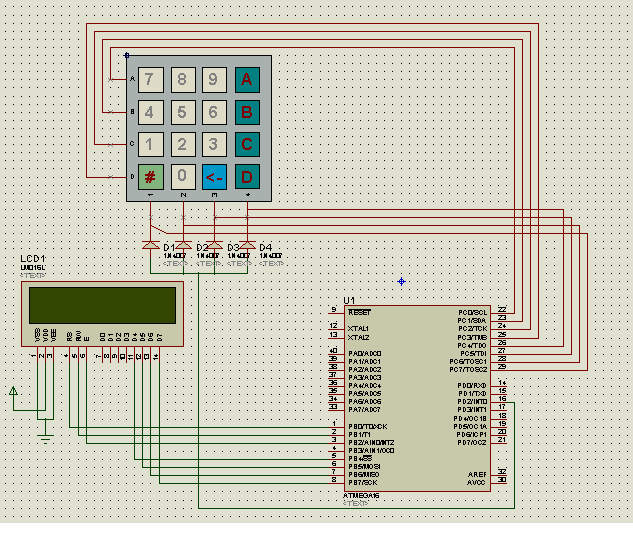
So, after entering the sleep mode it can be woken up by any interrupt source. Here I have used 4 diodes in such a way that when any of the keypad buttons is pressed they generate a low level pulse at the external interrupt INT0. INT0 is set to call its ISR routine function when such a thing happens. In short these diodes are working as an OR gate to detect any key pressed. If reader is new with keypad then reader can learn How to interface keypad with AVR.

 
After waking up, the microcontroller resumes from the position where it went to sleep,  thereby avoiding any risk of data mishandling.
 
 
For further references you can see the coding part as well.

The Keypad is connected to PORTC and the  LCD works on 4-bit mode with PORTB.

I have used a self-made header file for the keypad interfacing which you can find in this folder itself. 
 
A great thing about this lock is that it can remember your changed password. Now the question is how to change the password? It can be done when the safe is open; you just need to enter the new password that you want. Note that this password won’t be hidden, as it was at the unlocking time.


In other words at the time of unlocking, the LCD screen displays “*” for each time user presses a button. This is done to secure the password. But at the time of renewing it, LCD displays the same character pressed on the keypad just to ensure user about the password. Once the password has been changed everything becomes hidden again.
 
 
One more feature about this lock that would excite some of you is that you can even erase and rewrite your password. For erasing purposes, “<-” this button needs to be pressed.   
 
 
In my project I have used an LED as an indication about the lock status. When LED lights up it means unlocked status and when LED switches off it indicates the locked status.
 
 
In the coding part variable “i” plays an important role in deciding whether the microcontroller will go to sleep or not. A while loop runs till i<15000. “i” is incremented every time by one when no button is pressed but as soon as any button is pressed its value reaches to 0 and then again the whole process works accordingly.


Requirements

• Keypad 4X4
• Diode (1N4007)-4
• AtMega16
• LCD (16X2)
• Locking Mechanism (optional)
 

Circuit Diagram

Click on the Circuit Diagram Tab for Circuit Diagram 

Project Source Code

###

#include<avr/io.h>
#include<util/delay.h>
#include<lcd.h>
#include<keypad.h>

void function()
{
LCDclr();
LCDGotoXY(0,0);
LCDdisplay("ENTER PASSWORD");
LCDGotoXY(1,0);
}

int i=0,j=0;
char k=0,arr[16]="NUL",pass[16]="1234";

void main()
{
DDRA=1;
PORTA=0;
LCDinit();
LCDcursorOFF();
while(1)
{
if(PINA&1)
{
  LCDdisplay("SAFE OPEN");
  LCDGotoXY(1,0);
}
else
  function();
  while(i<15000)
{
  if(!k)
  i++;
  else
  {
   if(k!='#' && k!='E')
   {
   arr[j++]=k;
   if(PINA&1)
   LCDsendChar(k);
   else
   LCDsendChar('*');
   }
  else if(k=='E' && j!=0) 
   {
   j--;
   LCDcursorLeft(1);
   LCDsendChar(' ');
   LCDcursorLeft(1);
   }
  else if(k!='E')   
   {
   if(!strcmp(arr,"NUL"))
   {
    PORTA=0;
    LCDclr();
    LCDdisplay("SAFE LOCKED");
    _delay_ms(1000);
    function();
   }
   else 
    {
    arr[j]=' ';
    j=0;
    LCDclr();
    if(PINA&1)
    {
     if(strlen(arr)>=4)
    {
     strcpy(pass,arr);
     PORTA=0;//lock the safe
     LCDclr();
     LCDdisplay("SAFE LOCKED");
     _delay_ms(1000);
     function();
    }
    else
    {
     LCDdisplay("ERROR");
     LCDGotoXY(1,0);
     LCDdisplay("WEAK PASSWORD");
     _delay_ms(1000);
     LCDclr();
     LCDdisplay("SAFE OPEN");
     LCDGotoXY(1,0);
    }
    }
    else
{
     if(!strcmp(arr,pass))
     {
      LCDdisplay("SAFE OPEN");
      LCDGotoXY(1,0);
      PORTA=1;//open the safe
     }
     else
     {
      LCDdisplay("ERROR");
      LCDGotoXY(1,0);
      LCDdisplay("WRONG PASSWORD");
      _delay_ms(1000);
      function();
     }
    }
    strcpy(arr,"NUL");
   }
  }
  i=0;
}
k=Read_Keypad();
}
LCDclr();
DDRC=0x0f;
PORTC=0x00;
SREG|=(1<<7); //initializes the global interrupt i.e. sei();
DDRD&=~(1<<2); //declares INT0 as input pin
PORTD|=(1<<2); //pull-up enabled
GICR|=(1<<INT0); //enables INT0
GIFR|=(1<<INTF0); //enables INT0 flag for ISR recognition
MCUCR|=(1<<SM0)|(1<<SM1)|(1<<SE); //sleep mode enabled
MCUCR&=~(1<<SE); //sleep mode disabled
}
}

ISR(INT0_vect)
{
k=Read_Keypad();
GICR&=~(1<<INT0);
GIFR&=~(1<<INTF0);
i=0;j=0;strcpy(arr,"NUL");
}


###


Circuit Diagrams

Circuit-Diagram-AVR-ATMega16-Based-Smart-Keypad-Lock

Project Video


Filed Under: Electronic Projects
Tagged With: atmega16
 

Next Article

← Previous Article
Next Article →

Questions related to this article?
👉Ask and discuss on Electro-Tech-Online.com and EDAboard.com forums.


Tell Us What You Think!! Cancel reply

You must be logged in to post a comment.

EE TECH TOOLBOX

“ee
Tech Toolbox: Internet of Things
Explore practical strategies for minimizing attack surfaces, managing memory efficiently, and securing firmware. Download now to ensure your IoT implementations remain secure, efficient, and future-ready.

EE Learning Center

EE Learning Center
“engineers
EXPAND YOUR KNOWLEDGE AND STAY CONNECTED
Get the latest info on technologies, tools and strategies for EE professionals.

HAVE A QUESTION?

Have a technical question about an article or other engineering questions? Check out our engineering forums EDABoard.com and Electro-Tech-Online.com where you can get those questions asked and answered by your peers!


RSS EDABOARD.com Discussions

  • Voltage mode pushpull is a nonsense SMPS?
  • Input impedance matching network
  • High Side current sensing
  • The comparison of different Tcl script checkers
  • Reducing "shoot-through" in offline Full Bridge SMPS?

RSS Electro-Tech-Online.com Discussions

  • Is AI making embedded software developers more productive?
  • Back to the old BASIC days
  • Parts required for a personal project
  • PIC KIT 3 not able to program dsPIC
  • Failure of polypropylene motor-run capacitors

Featured – RPi Python Programming (27 Part)

  • RPi Python Programming 21: The SIM900A AT commands
  • RPi Python Programming 22: Calls & SMS using a SIM900A GSM-GPRS modem
  • RPi Python Programming 23: Interfacing a NEO-6MV2 GPS module with Raspberry Pi
  • RPi Python Programming 24: I2C explained
  • RPi Python Programming 25 – Synchronous serial communication in Raspberry Pi using I2C protocol
  • RPi Python Programming 26 – Interfacing ADXL345 accelerometer sensor with Raspberry Pi

Recent Articles

  • What is AWS IoT Core and when should you use it?
  • AC-DC power supply extends voltage range to 800 V DC
  • Infineon’s inductive sensor integrates coil system driver, signal conditioning circuits and DSP
  • Arm Cortex-M23 MCU delivers 87.5 µA/MHz active mode
  • STMicroelectronics releases automotive amplifiers with in-play open-load detection

EE ENGINEERING TRAINING DAYS

engineering

Submit a Guest Post

submit a guest post
Engineers Garage
  • Analog IC TIps
  • Connector Tips
  • Battery Power Tips
  • DesignFast
  • EDABoard Forums
  • EE World Online
  • Electro-Tech-Online Forums
  • EV Engineering
  • Microcontroller Tips
  • Power Electronic Tips
  • Sensor Tips
  • Test and Measurement Tips
  • 5G Technology World
  • Subscribe to our newsletter
  • About Us
  • Contact Us
  • Advertise

Copyright © 2025 WTWH Media LLC. All Rights Reserved. The material on this site may not be reproduced, distributed, transmitted, cached or otherwise used, except with the prior written permission of WTWH Media
Privacy Policy

Search Engineers Garage

  • Electronic Projects & Tutorials
    • Electronic Projects
      • Arduino Projects
      • AVR
      • Raspberry pi
      • ESP8266
      • BeagleBone
      • 8051 Microcontroller
      • ARM
      • PIC Microcontroller
      • STM32
    • Tutorials
      • Audio Electronics
      • Battery Management
      • Brainwave
      • Electric Vehicles
      • EMI/EMC/RFI
      • Hardware Filters
      • IoT tutorials
      • Power Tutorials
      • Python
      • Sensors
      • USB
      • VHDL
    • Circuit Design
    • Project Videos
    • Components
  • Articles
    • Tech Articles
    • Insight
    • Invention Stories
    • How to
    • What Is
  • News
    • Electronic Product News
    • Business News
    • Company/Start-up News
    • DIY Reviews
    • Guest Post
  • Forums
    • EDABoard.com
    • Electro-Tech-Online
    • EG Forum Archive
  • DigiKey Store
    • Cables, Wires
    • Connectors, Interconnect
    • Discrete
    • Electromechanical
    • Embedded Computers
    • Enclosures, Hardware, Office
    • Integrated Circuits (ICs)
    • Isolators
    • LED/Optoelectronics
    • Passive
    • Power, Circuit Protection
    • Programmers
    • RF, Wireless
    • Semiconductors
    • Sensors, Transducers
    • Test Products
    • Tools
  • Learn
    • eBooks/Tech Tips
    • Design Guides
    • Learning Center
    • Tech Toolboxes
    • Webinars & Digital Events
  • Resources
    • Digital Issues
    • EE Training Days
    • LEAP Awards
    • Podcasts
    • Webinars / Digital Events
    • White Papers
    • Engineering Diversity & Inclusion
    • DesignFast
  • Guest Post Guidelines
  • Advertise
  • Subscribe