Battery electric vehicles (EVs) have showcased rapidly growing sales figures over the last several years. There are several reasons to consider an EV aside from saving on gasoline. The prominent one, of course, is the environment. EVs have no tailpipe emissions, and research shows that they’re responsible for lower levels of greenhouse gases (GHGs) than the average new (and old) gasoline car.
EVs are also becoming a more pocket-friendly alternative to conventional vehicles — particularly over time. They offer lower running costs and cheaper maintenance than gas guzzlers over a five-year period and longer.
The charging infrastructure, a critical accessory for EVs, is under ongoing development. Unfortunately, the EV plug standards are not universal and vary per city and country. In this article, we’ll discuss several different vehicle-side EV connector types and compare them. We’ll also discuss why specific connector types are adopted in different geographies.
The charging stations
A charging cable has two connectors — one plugs into the vehicle socket, and the other plugs into the charging station. Electric vehicles charge similarly to mobile phones.
There are two types of charging stations for EVs. One is the slow/fast charging stations typically installed at homes and offices for top-up charging. These stations draw AC power from a main power source, taking several hours to charge the vehicles. Often, EV owners will charge their vehicle overnight using these stations.
The other type is a rapid or high-speed charging station installed in public places or major freeways. They directly charge the vehicle battery with DC power, usually in less than half an hour. However, DC fast-charging must not be done more than once or twice a week as it has a harmful effect on a battery’s lifespan.
Rapid charging is most suitable for long journeys, while overnight slow/fast charging is ideal for daily commuting. Different EV charging connectors exist for slow/fast AC charging and DC rapid charging.
AC charging connectors
The following EV charging connectors are used for AC charging.
1. Type 1 connector (J1772/IEC60309)
2. Type 2 connector (Mennekes/IEC62196)
3. GB/T
The Type 1 connector is the standard U.S. connector for AC-charging EVs, though you’ll also find it throughout Japan. It has five pins and lacks any locking mechanism. These connectors charge EVs using a single-phase AC from the mains.
The typical power ratings are 3.7 and 7 kW, capable of charging for 20 and 40 km range per hour, respectively. The connector is a 15V outlet with region-based AC frequency. The output voltage is indicated by the color of the cable. For the 50~60 Hz AC, a yellow cable indicates a 100~130V output; a blue cable indicates a 200~250V output; and a red cable indicates a 380~480V output.
The fitting is often done in outdoor settings. The connector is weatherproof to IP44 standard.

The Type 2 connector is the standard EU connector for AC charging EVs and is fairly common in India. It has seven pins with an in-built locking mechanism. These connectors are capable of charging EVs with single and three-phase ACs.
The typical power ratings for single-phase AC charging are 3.7 and 7 kW, capable of charging for 20 and 40 km range per hour, respectively. The three-phase charging has a power rating of 22 kW, capable of charging for 120 km range per hour. Of the seven pins, three are line phase, two are signaling pins, one pin is earth, and one is neutral.
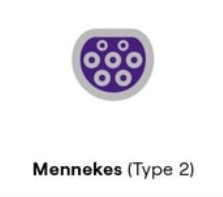
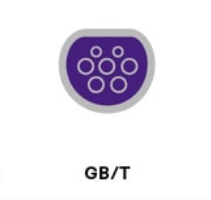
The GB/T connector is primarily used in China. The connector has seven pins with an in-built locking mechanism. There are two charging modes — one with a 250V output and the other with a 440V output. Both charging modes have a maximum power output of 27.7 kW.
No three-pin plugs, please
There are reasons why the typical three-pin home plugs are not used for charging EVs. For one, they cannot output more than 10Wh and they do not provide two-way communication. Also, they’re not weather-proof and are only meant for indoor settings.
DC charging connectors
The following EV charging connectors are used for DC rapid charging.
1. CHAdeMO
2. Combined Charging System (CCS)
3. GB/T
CHAdeMO is the original DC connector developed by the Japanese utility, Tepco, and is typically only used in Japan. With a 125A outlet, the connector can deliver power rates of 50 and 100 kW, capable of charging for 120 and 240 km range per hour, respectively.
The latest CHAdeMO EV Connector Specification 2.0 can deliver a power rating of 400 kW. This connector use CAN protocol for communication between EVs and the charging station.

The Combined Charging System (CCS) is the EU rapid-charging standard. It’s based on the J1772 connector and includes two additional pins, enabling high-speed charging on J1772 connectors by making a 2x Type 2 pin arrangement.
This connector can deliver 50, 150, and 350 kW power rates, charging for 120, 360, and 840 km range per hour, respectively.
In North America, the CCS1 is the standard plug type, while in EU CCS2 is the standard plug type. Both the CCS1 and CCS2 have the same DC pin architecture and communication protocol. The CCS connector uses PLC for communication between EVs and the charging station.
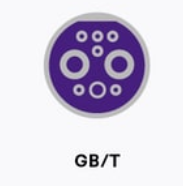
 The GB/T connector is primarily used in China for DC rapid charging. It has an output voltage of 750/1000V and a current rating of 80~250A. The maximum power output is 250 kW.
Tesla
Tesla has proprietary connectors, although it has started adopting CCS connectors for DC charging. The CCS and CHAdeMO connectors are also in the process of converging efforts to support universal charger standards.
The regions
In North America, the Type 1 connector is the standard plug type for AC charging and the CCS1 for DC charging. In Japan, the Type 1 connector is also the standard type for AC charging, while CHAdeMO is used for DC charging. In the EU and India, the Type 2 connector is the standard plug type for AC charging, and the CCS2 is used for DC rapid charging. The GB/T is the standard plug type in China. In India, many automobile manufacturers also use the CHAdeMO and GB/T for DC charging EVs.
A universal standard
There are several reasons why there are different plug architectures for EV charging in different parts of the world. For AC charging, the variations emerged due to different mains supplies. For DC charging, the differences relate to the origin of charging technology. China has its own charging plug standards because of state policies.
Automotive manufacturers and organizations are moving toward a universal plug standard. For example, the CCS and CHAdeMO standards are in the process of converging. But a global one-size-fits-all EV charging infrastructure might never happen. Time will tell.
You may also like:

Filed Under: ARM, Automotive, Electric Vehicles, EVs, Tech Articles, Tutorials
Questions related to this article?
👉Ask and discuss on EDAboard.com and Electro-Tech-Online.com forums.
Tell Us What You Think!!
You must be logged in to post a comment.