Electric vehicles are shaping the future of mobility and, as nearly all electric vehicles are turning out to be more economical compared to any gasoline car, there has been a shift in the buying trend of automobiles. It is expected that there will be more electric cars on the road than fossil fuel cars by 2030. Presently, typical electric cars have a range of 300 to 400 km on full battery recharge. This is more than sufficient for day-to-day commuting. The battery pack of an electric car is expected to run for at least five to eight years without the need for the replacement or repair of cells.
As more electric cars are showing up on roads, the need for charging stations is also growing tremendously. In the US alone, there are 56,000 charging stations with 148,000 charging ports in total — and yet it is still not enough to meet the growing demand for EVs. Countries like India expect to require 700,000 EV charging stations by 2030. While at present, a major challenge is to find effective ways for fast charging electric cars, setting up nationwide EV charging facilities is another challenge.
In the quest to set up an effective and elaborate EV charging infrastructure, automobile manufacturers are looking forward to new ways of charging electric vehicles. One feasible solution for simultaneously charging multiple electric cars is wireless EV charging stations (WEVCS). These wireless charging stations work similarly to wireless chargers of mobile phones. Such charging stations can be set up in parking lots allowing automatic charging of electric cars during the halt. Another option is dynamic wireless charging which allows charging the electric vehicle while it is in motion. While dynamic charging promises a longer EV range, it has risks of environmental and health hazards.
Static wireless charging
Static wireless charging is the most feasible and safest wireless charging technology. Static charging means the electric car is charged at a wireless charging station while it is at a halt. Such a setup can be easily installed in parking lots and motor garages. In this type of wireless charging, the transmitter is installed underground, and the electric car has an onboard receiver at the bottom. When the car parks at a parking lot or inside the garage, the transmitter and receiver get aligned, and the car starts charging. The rate of charging depends upon the AC voltage level. While the car remains parked, it is wirelessly charged without any need for plugging in cables. This is a practical, easy, and efficient manner of charging electric vehicles.
Dynamic wireless charging
Dynamic charging is another EV charging infrastructure concept. In this setup, stationary power transmitters are installed on roads and highways. The electric vehicles charge while they are in motion as they come into the vicinity of stationary transmitters. This type of charging definitely promises a longer EV range on the go. The setup for dynamic charging, however, would come at a significant cost as it would involve constructing the equivalent of EV charging setups across entire roads and highways. How effective it would be able to charge moving vehicles is another concern as wireless charging requires perfect alignment of the transmitter and receiver. Additionally, such a setup also imposes threats related to safety, environmental effects, and health hazards.
How wireless charging works
Wireless charging was first demonstrated by Nicola Tesla when he developed Tesla Coil. Wireless charging works on the same principle a transformer works. Like in a transformer, the secondary coil is exited due to the magnetic field developed by the current flow in the primary coil — the same way a wireless charger has a transmitter and the charging device has a receiver. When alternating current flows through the transmitter, it creates an alternating magnetic field that transfers current to the receiver. This is the basic working of any wireless charger be it designed for mobile phones or electric cars. There is not, however, one method of wireless charging. There are four different recognized methods as follows:
- Capacitive Wireless Charging System (CWCS)
- Permanent Magnetic Gear Wireless Charging System (PMWC)
- Inductive Wireless Charging System (IWC)
- Resonant Inductive Wireless Charging System (RIWC)
Capacitive Wireless Charging System (CWCS)
This type of charging is based on the principle of electrostatic induction seen in capacitors. The electric car has a receiver plate at its bottom, and the charging station has a transmitter plate at the ground. The air gap between the two plates acts as a dielectric medium. The electric car is charged by the displacement current in the receiver plate due to variations in the electric field by the transmitter plate. At the transmitter side, AC current is first supplied to a power factor correction circuit. The circuit maintains voltage levels and minimizes transmission losses. The voltage is then passed through an H-bridge generating a high-frequency AC voltage, which is applied to the transmission plate. The high-frequency AC voltage — typically in the range of 100 to 600 KHz — causes an oscillating electric field. This generates a displacement current at the receiver plate. The amount of current received at the receiver plate depends on several factors, such as the alignment of the transmitter and receiver plate, the air gap between the two plates, applied AC voltage, the material used in the construction of plates, and the frequency of AC voltage. At the receiver side, the displacement current is used to charge the battery pack of the electric car with the help of a rectifier and filter circuit.
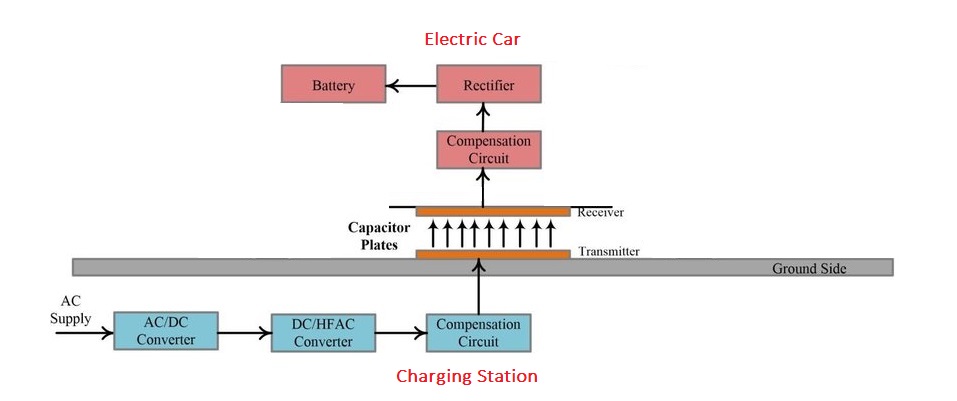
Working of capacitive wireless charging in electric vehicles
Permanent Magnetic Gear Wireless Charging System (PMWC)
This type of wireless charging is based on the working principle of an electric motor. Both transmitter and receiver consist of an armature winding with synchronized permanent magnets placed as the core within the windings. Mechanical torque is generated when AC voltage is applied to the transmitter winding due to permanent magnets. Changes in the permanent magnetic field of the transmitter cause synchronized mechanical torque to be induced in the receiver’s permanent magnet, producing AC current in the receiver winding. The receiver is converted into a power generator as the mechanical torque in the receiver’s permanent magnet is converted to alternating current in its winding. The coupling of rotating permanent magnets is called magnetic gear. At the receiver side, the AC current from the magnetic gear is rectified and filtered to charge the battery pack of the electric car.
This method of wireless charging has several disadvantages. Firstly, due to the use of permanent magnets, the charging setup gets costly. Secondly, permanent magnets are prone to breaking under mechanical stress. So, the charging setup could run into high maintenance costs.
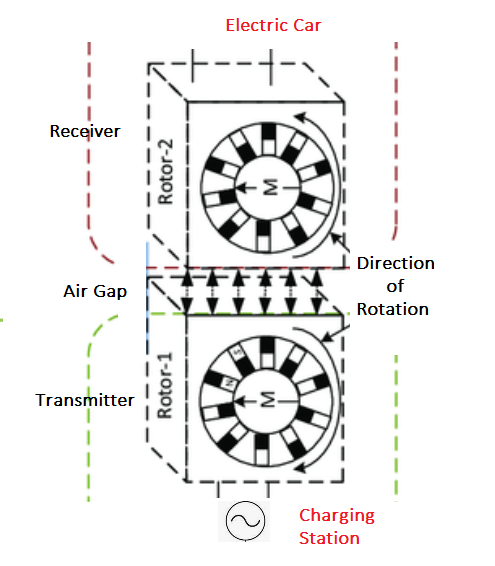
Working of permanent magnet gear wireless charging in electric vehicles
Inductive Wireless Charging System (IWC)
This type of wireless charging is based on the working principle of a transformer. Both transmitter and receiver consist of coils. The transmitter coil is installed at the ground while the receiver coil rests at the bottom of the electric car. An AC voltage of frequency in the range of 19~50 KHz is passed through the transmitter coil. This causes a change in the magnetic field at the receiver coil producing AC current. The AC current inducted in the receiver coil is rectified and filtered to charge the battery pack of the electric car using its battery management system. This is the most cost-effective method of wireless charging electric cars. The charging works just like electricity is transferred between the primary and secondary winding of a transformer. As transformers are one of the cheapest electronic components and easiest to construct, this method of wireless charging is the most economical and simplest to implement. The coils need to be in alignment for wireless charging. The rate of charging in an inductive wireless charging system depends on the distance between the transmitter and receiver coil, the mutual inductance between them, and the frequency of the applied AC supply.
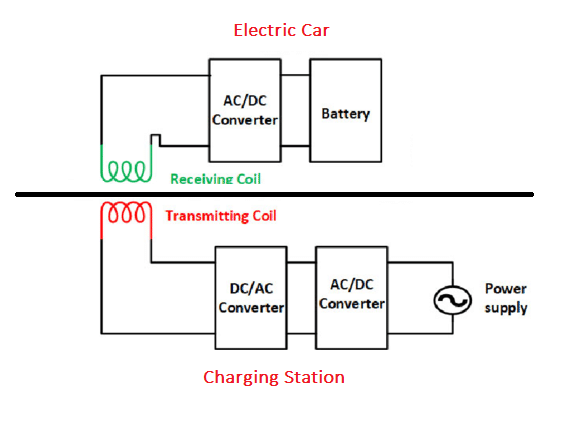
Working of inductive wireless charging in electric vehicles
Resonant Inductive Wireless Charging System (RIWC)
Resonant wireless charging is an improved method of inductive wireless charging and the most cost-effective and efficient wireless charging method. When the primary and secondary coils in a transformer are tuned to the same resonant frequency, the electrical energy from the primary coil is transferred to the secondary coil at a much faster rate. When the coils are in resonance, the transfer of electrical energy happens even if the magnetic field between them is weak. The method of resonant inductive wireless charging improves the power transfer efficiency and provides a high-quality factor. It has the same cost benefits as inductive charging, plus it provides higher efficiency, lower losses, and enables faster charging. If the resonant frequency at both coils is matched, the electrical power is transferred despite the greater distance between the coils. Compensation networks are added at both sides in series and parallel for matching resonant frequency at the transmitter and receiver coil in a resonant inductive charging system. Some additional compensation networks may be added to further minimize the power losses. The operating frequency in this type of charging remains 10 to 150 KHz. The integration of additional circuits for matching resonant frequency does add some additional cost to the wireless charging setup at both the transmitter and receiver sides. The additions are worth it considering the improved power efficiency and faster charging rates.
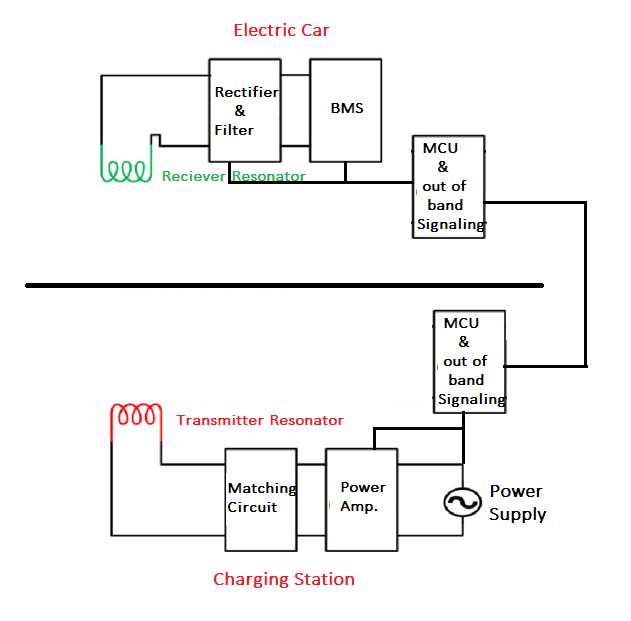
Working of resonant inductive wireless charging in electric vehicles
Challenges in EV wireless charging
Many automobile manufacturers are working towards wireless charging as it will be of great benefit to the EV ecosystem. There are, however, a lot of challenges in the EV segment, such as fast charging, safe battery technology, electric motor efficiency, battery management, safety, and implementation of EV technology in different automotive segments.
The biggest challenge for wireless EV charging is its adoption by automobile manufacturers and the companies’ involvement in the development of charging stations. Wireless charging needs to prove itself to be much more cost-effective and efficient than cable charging to propel its adoption The environmental impact of wireless charging is another important issue as the charging stations need to comply with strict EMC and EMI standards to overcome these concerns.
WEVCS standards
Many international organizations like the Society of Automotive Engineers (SEA), the International Electro-technical Commission (IEC), and the Institute of Electrical and Electronics Engineers (IEEE) are actively working together to develop a global standard for wireless EV charging. Plug-in charging has a maximum efficiency of 94 to 94.5 percent but the latest SEA standards for wireless charging have shown up an efficiency of 90~92 percent — nearly eliminating that critical roadblock in the adoption of wireless charging.
You may also like:

Filed Under: ARM, EVs, Tech Articles, Tutorials
Questions related to this article?
👉Ask and discuss on Electro-Tech-Online.com and EDAboard.com forums.
Tell Us What You Think!!
You must be logged in to post a comment.