Engineers Garage

  • Electronic Projects & Tutorials
    • Electronic Projects
      • Arduino Projects
      • AVR
      • Raspberry pi
      • ESP8266
      • BeagleBone
      • 8051 Microcontroller
      • ARM
      • PIC Microcontroller
      • STM32
    • Tutorials
      • Audio Electronics
      • Battery Management
      • Brainwave
      • Electric Vehicles
      • EMI/EMC/RFI
      • Hardware Filters
      • IoT tutorials
      • Power Tutorials
      • Python
      • Sensors
      • USB
      • VHDL
    • Circuit Design
    • Project Videos
    • Components
  • Articles
    • Tech Articles
    • Insight
    • Invention Stories
    • How to
    • What Is
  • News
    • Electronic Product News
    • Business News
    • Company/Start-up News
    • DIY Reviews
    • Guest Post
  • Forums
    • EDABoard.com
    • Electro-Tech-Online
    • EG Forum Archive
  • DigiKey Store
    • Cables, Wires
    • Connectors, Interconnect
    • Discrete
    • Electromechanical
    • Embedded Computers
    • Enclosures, Hardware, Office
    • Integrated Circuits (ICs)
    • Isolators
    • LED/Optoelectronics
    • Passive
    • Power, Circuit Protection
    • Programmers
    • RF, Wireless
    • Semiconductors
    • Sensors, Transducers
    • Test Products
    • Tools
  • Learn
    • eBooks/Tech Tips
    • Design Guides
    • Learning Center
    • Tech Toolboxes
    • Webinars & Digital Events
  • Resources
    • Digital Issues
    • EE Training Days
    • LEAP Awards
    • Podcasts
    • Webinars / Digital Events
    • White Papers
    • Engineering Diversity & Inclusion
    • DesignFast
  • Guest Post Guidelines
  • Advertise
  • Subscribe

Constrained Application Protocol : IOT Part 32

By Priya May 4, 2024

IoT devices have very limited resources like they have embedded processors or controllers, limited RAM and ROM and they need to operate on battery without replacement for weeks, months or even years. Even they have to communicate data swiftly though small in amount but on limited network bandwidth. Bringing the web to constrained devices that lack the capabilities of computer and smart phones require special sort of IoT protocol. The Constraint Application Protocol (CoAP) is one of such protocols designed to fit this requirement.
Constrained Application Protocol (aka CoAP) is a specialized web transfer protocol for use with constrained nodes (low power sensors and actuators) and constrained networks (low power, lossy network). It enables those nodes to be able to talk with other constrained nodes over Internet. The protocol is specifically designed for M2M applications such as smart energy, home automation and many Industrial applications.
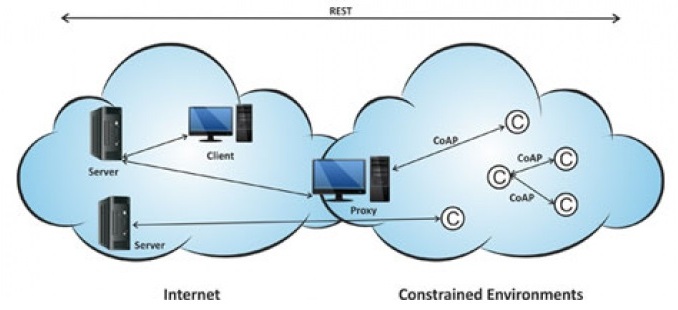
Overview of CoAP Protocol for Constraint Devices
Fig. 1: Overview of CoAP Protocol for Constraint Devices
CoAP protocol is necessary because traditional protocols such as TCP/IP are considered “too heavy” for IoT applications that involves constrained devices. CoAP protocol runs on devices that support UDP protocol. In UDP protocol, client and server communicate through connectionless datagrams.
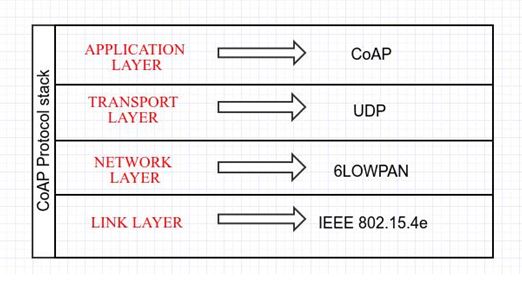
Image showing CoAP Protocol Stack
Fig. 2: Image showing CoAP Protocol Stack
As it is a web transfer protocol, it is based on RESTful architecture which provides a request/response interaction model between application endpoints and supports built-in discovery of services and resources. Like HTTP, Servers make resources under URL and clients access those resources using methods such as GET, PUT, POST and DELETE.
The CoAP protocol has the following features –
1) It provides M2M communication in constrained environment.
2) It provides security of data by datagram transportation layer security (DTLS).
3) Asynchronous message exchange.
4) Low header overhead and parsing complexity
5) URI and content type support
6) UDP binding with optional reliability supporting unicast and multicast requests.
The CoAP is different from other protocols. When compared with HTTP, CoAP is implemented for IoT and M2M environment to send messages over UDP protocol. To compensate for the unreliability of UDP protocol, CoAP defines a retransmission mechanism and provides resource discovery mechanism with resource description.
The MQTT and CoAP, both are designed to consider the long term vision that they need to be used in lightweight environments. Both works well with low power and network constrained devices. So the choice really depends on the application. If a M2M network  has to be created where messages must publish from one node to multiple interested nodes, the best choice will be to use MQTT protocol. But if a M2M network  has to be created where commands must be sent to among nodes, CoAP will be the best choice for that. For example to control an AC from the smart phone, CoAP would be the smarter choice.
CoAP should be on priority for the following three factors –
• Quality of service with confirmable message
• When multicast support is needed
• Very low overhead and simplicity.
RESTful Architecture –
CoAP follows a client-server communication model. Client makes request to the server and the server sends back the responses to the client.  Client can GET, PUT, POST or DELETE the resources on network. CoAP improves the HTTP request model with the ability to observe a resource. In HTTP, the server needs to do polling again and again to check where there is any state changes to the client or not. Whereas in CoAP, the observe flag is set on the CoAP GET request, the server continues to reply after the initial document has been transferred. This allows servers to stream the state changes to clients as they occur. Any end can stop the observation.
The CoAP defines a standard mechanism for resource discovery. Servers provide a list of their resources, along with metadata about them, at /.well-known/core. For Quality of Service (QoS), Requests and response messages may be marked as confirmable or non-confirmable. Confirmable messages must be acknowledged by the receiver. Non-confirmable messages are “fire and forget” type.
CoAP Protocol Security –
The main concern from security point of view is to provide Data Integrity, Data Authentication and Data Confidentiality. The CoAP provides security over Datagram Transportation Layer Security in Application layer. As CoAP runs over UDP protocol stack, there are chances of data loss or data disordering. But with DTLS security, these two problems can be solved. DTLS security adds three implementations to CoAP –
1) Packet retransmission
2) Assigning sequence number within handshake
3) Replay detection
The security is designed to prevent eavesdropping, tampering or data forgery at any cost. Unlike network layer security protocols, DTLS in application layer protect end-to-end communication. DTLS also avoids cryptographic overhead problems that occur in lower layer security protocols.
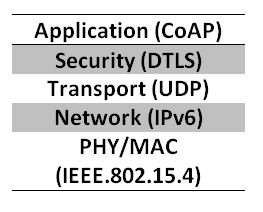
Image showing CoAP Protocol at Application Layer in Network Architecture
Fig. 3: Image showing CoAP Protocol at Application Layer in Network Architecture


There is a Secured Handshake Mechanism in DTLS as shown in image below –
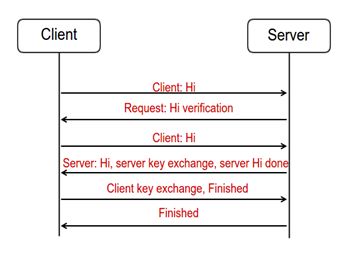
Image showing DTLS Secured Handshake Mechanism for CoAP
Fig. 4: Image showing DTLS Secured Handshake Mechanism for CoAP
The CoAP can also be implemented over TCP and over TLS. Check out the following official documentation for CoAP implementation over TCP and TLS.
TCP and TLS Transport for the Constrained Application Protocol (CoAP)  
In the next tutorial – Client Server Communication over CoAP Protocol, an ESP8266 module is configured as server and a Browser on a laptop is configured as Client. The CoAP Client sends some data to the server and the server acknowledges it by switching an LED on.

You may also like:


  • What are the top 4G modems available in India?

  • What are the top development boards for AI and ML?

  • What are LoRa gateways and what types are available?

  • How does LoRa modulation enable long-range communication?

  • What is the role of embedded software in electric vehicles?

  • What are the top tools for developing embedded software?

Filed Under: IoT tutorials, Tutorials


Next Article

← Previous Article
Next Article →

Questions related to this article?
👉Ask and discuss on EDAboard.com and Electro-Tech-Online.com forums.


Tell Us What You Think!! Cancel reply

You must be logged in to post a comment.

EE TECH TOOLBOX

“ee
Tech Toolbox: Internet of Things
Explore practical strategies for minimizing attack surfaces, managing memory efficiently, and securing firmware. Download now to ensure your IoT implementations remain secure, efficient, and future-ready.

EE Learning Center

EE Learning Center
“engineers
EXPAND YOUR KNOWLEDGE AND STAY CONNECTED
Get the latest info on technologies, tools and strategies for EE professionals.

HAVE A QUESTION?

Have a technical question about an article or other engineering questions? Check out our engineering forums EDABoard.com and Electro-Tech-Online.com where you can get those questions asked and answered by your peers!


RSS EDABOARD.com Discussions

  • Reducing "shoot-through" in offline Full Bridge SMPS?
  • High Side current sensing
  • How to simulate power electronics converter in PSpice?
  • Voltage mode pushpull is a nonsense SMPS?
  • Layout IRN reduction in Comparator

RSS Electro-Tech-Online.com Discussions

  • Back to the old BASIC days
  • Parts required for a personal project
  • PIC KIT 3 not able to program dsPIC
  • Failure of polypropylene motor-run capacitors
  • Siemens large industrial PLC parts

Featured – RPi Python Programming (27 Part)

  • RPi Python Programming 21: The SIM900A AT commands
  • RPi Python Programming 22: Calls & SMS using a SIM900A GSM-GPRS modem
  • RPi Python Programming 23: Interfacing a NEO-6MV2 GPS module with Raspberry Pi
  • RPi Python Programming 24: I2C explained
  • RPi Python Programming 25 – Synchronous serial communication in Raspberry Pi using I2C protocol
  • RPi Python Programming 26 – Interfacing ADXL345 accelerometer sensor with Raspberry Pi

Recent Articles

  • What is AWS IoT Core and when should you use it?
  • AC-DC power supply extends voltage range to 800 V DC
  • Infineon’s inductive sensor integrates coil system driver, signal conditioning circuits and DSP
  • Arm Cortex-M23 MCU delivers 87.5 µA/MHz active mode
  • STMicroelectronics releases automotive amplifiers with in-play open-load detection

EE ENGINEERING TRAINING DAYS

engineering

Submit a Guest Post

submit a guest post
Engineers Garage
  • Analog IC TIps
  • Connector Tips
  • Battery Power Tips
  • DesignFast
  • EDABoard Forums
  • EE World Online
  • Electro-Tech-Online Forums
  • EV Engineering
  • Microcontroller Tips
  • Power Electronic Tips
  • Sensor Tips
  • Test and Measurement Tips
  • 5G Technology World
  • Subscribe to our newsletter
  • About Us
  • Contact Us
  • Advertise

Copyright © 2025 WTWH Media LLC. All Rights Reserved. The material on this site may not be reproduced, distributed, transmitted, cached or otherwise used, except with the prior written permission of WTWH Media
Privacy Policy

Search Engineers Garage

  • Electronic Projects & Tutorials
    • Electronic Projects
      • Arduino Projects
      • AVR
      • Raspberry pi
      • ESP8266
      • BeagleBone
      • 8051 Microcontroller
      • ARM
      • PIC Microcontroller
      • STM32
    • Tutorials
      • Audio Electronics
      • Battery Management
      • Brainwave
      • Electric Vehicles
      • EMI/EMC/RFI
      • Hardware Filters
      • IoT tutorials
      • Power Tutorials
      • Python
      • Sensors
      • USB
      • VHDL
    • Circuit Design
    • Project Videos
    • Components
  • Articles
    • Tech Articles
    • Insight
    • Invention Stories
    • How to
    • What Is
  • News
    • Electronic Product News
    • Business News
    • Company/Start-up News
    • DIY Reviews
    • Guest Post
  • Forums
    • EDABoard.com
    • Electro-Tech-Online
    • EG Forum Archive
  • DigiKey Store
    • Cables, Wires
    • Connectors, Interconnect
    • Discrete
    • Electromechanical
    • Embedded Computers
    • Enclosures, Hardware, Office
    • Integrated Circuits (ICs)
    • Isolators
    • LED/Optoelectronics
    • Passive
    • Power, Circuit Protection
    • Programmers
    • RF, Wireless
    • Semiconductors
    • Sensors, Transducers
    • Test Products
    • Tools
  • Learn
    • eBooks/Tech Tips
    • Design Guides
    • Learning Center
    • Tech Toolboxes
    • Webinars & Digital Events
  • Resources
    • Digital Issues
    • EE Training Days
    • LEAP Awards
    • Podcasts
    • Webinars / Digital Events
    • White Papers
    • Engineering Diversity & Inclusion
    • DesignFast
  • Guest Post Guidelines
  • Advertise
  • Subscribe