“Machines are made to do what man never can. Well, guess who makes the machines?”
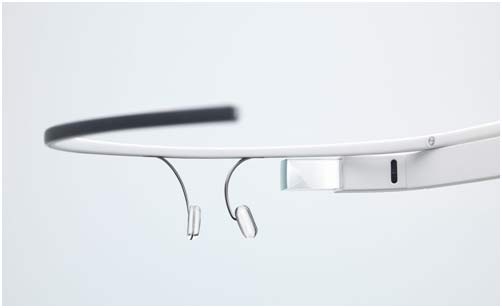
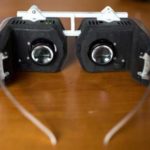
Fig. 1: Representational Image of a Google Glass
We had all imagined what the future would be like in our childhood, picturing pretty intense technology like flying cars, houses floating in the air, holographic telephones, etc. But we look at the world now and see those ideas actually come to life. One of such devices is Google’s latest project, “Google Glass”. What is Google Glass? What does it promise to do? What are its salient features? We will find out all this and more as we go further.
In simple terms, google glass is a computer which you can wear on your head the same way as in you would wear a set of spectacles, which comes with an Optical Head Mounted Display (OHMD) working on a class of technology called “Augmented Reality”. Therefore, the display of this device is visible in front (upper right corner) of your vision via a prism projector lens. It possesses most of the features of a modern smartphone. It is controlled by voice command, and can take pictures and record videos of what you see. It has been developed by Google X (still in beta test phase), a special sector in google responsible for the development of futuristic technologies. Google X is also responsible for the development of the driverless car.
Check how it feels through Google Glass.
Technical Specifications
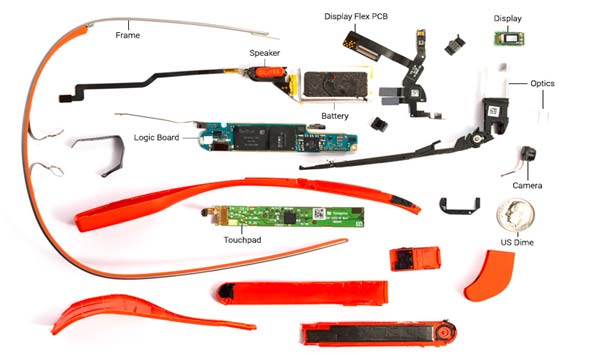
Fig. 2: Google Glass Technical Specifications
Google Glass runs on Android (version 4.0.4 ‘IceCream Sandwich’ or higher), which is an open source operating system (proprietorship of google inc.) used in many of today’s smartphones. The android operating system allows developers to create program applications which utilize the various hardware and software capabilities onboard the glass. It provides space for customizations to be applied on the device.
It has a 5 megapixel camera which can record videos in 720p HD resolution with a simple voice command or a tap on the touchpad on the side. The camera is very much similar to the ones used in smartphone devices.
A display of resolution 640×360 powered by a prism projector is used. According to google, this resolution with respect to size is the equivalent to watching a 25 inch High definition screen from two and a half meters away. The display unit is also located on a flex PCB (Printed Circuit Board) holding sensors such as InvenSense MPU-9150 (which is a glass inertial sensor), Wolfson WM7231 MEMS microphone, there is an additional microphone on the main board which will probably back up as a noise cancelling device.
A lithium polymer rechargeable battery with a 560mAh capacity provides a day’s usage with typical usage. The battery unit is provided in the back section of the case to structurally balance out the forward load of the optics module and the CPU board. The battery is NOT user replaceable.
The main CPU board located in the heart of the controls case. On the PCB (Printed Circuit Board) there are the core processors, 16GB SanDisk flash drive module, Wi-Fi and Bluetooth module, Elpida mobile DRAM chipset along with a few RF devices. There is an onboard 16GB of internal storage out of which 12GB is available to the user. Glass also syncs with your google drive account online to stash photos and videos.It runs a RAM of 1GB out of which 628MB is available for application use.
There is a Bluetooth and Wi-Fi unitbuilt on to the main CPU circuit. There is no GPS on board but can be paired with an android smartphone to enable google maps.
The google glass also has a touchpad on the side of the optic bearing arm, providing touch input. It can be swiped back and forth to switch between the various screens of the interface in a timeline like layout. The touchpad is developed by Synaptics driven by a Synaptics T1320A touchpad controller, which is an interface between the software and hardware.
Sound is transferred through a relatively new technology called “Bone conduction Transfer” which vibrates your skull which signals the eardrum, therefore making it almost inaudible to the people surrounding the user. The bone conduction speaker also doubles as a tactile switch.
Glass is also controlled by voice commands, through microphone. The device is activated by the user tilting their head 30o upwards (can be changed). Additionally it can also be activated by tapping the touchpad and saying “OK, Glass”. The camera is controlled by saying “Take a picture” or “Record a video”. Many other functions such as google searches, mail, directions and android applications can be controlled through voice.
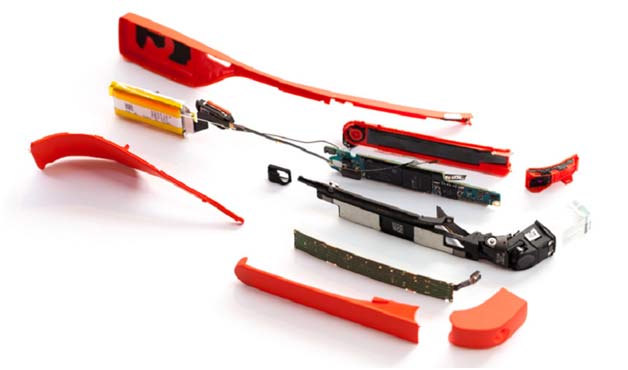
Fig. 3: Mini Proyector Google Glass
The following are the expected technical specifications of google glass
Operating System: Android (4.0.4 and higher).
CPU: 1.2GHz Dual Core Processor by Texas Instruments
Internal Storage: 16 Giga Bytes Sandisk flashdrive.
Memory: 1 Giga Byte RAM.
Power: Lithium Polymer Battery (560mAh).
Sound: Bone Conduction Transducer.
Display: Prism Projected Display with 640×360 pixel resolution.
Camera: 5 Megapixel with 720p recording capability.
Sensors: Proximity, Ambient light, Magnetometer, Microphone, Gyroscope, Accelerometer, Touchpad.
Connectivity: Bluetooth, Wi-Fi 802.11b/g, Micro USB.
Weight: 50grams.
At present, google glass has only released a beta device available to a select number of individuals (developers and explorers) with a price tag of 1500$ (Roughly INR 90,000). The consumer version is also expected to be available at a much lower price (at about the cost of an IPhone) owning to subsidy from their success of the Nexus 7.
Design
The google glass is designed to be lightweight and completely unobtrusive (thanks to the titanium frame). It has an extremely robust body with a frame that comes with additional pads for comfort. It has a touchpad along one of the arm for interaction. The current explorer version does not provide for the attachment of prescription lenses if you already wear glasses, but the consumer version promises a provision for the integration of prescription lenses in the frame of Glass. Currently google glass is expected to come out in five colors; Charcoal (black), Tangerine (orange), Shale (grey), Sky (blue) and Cotton (white).
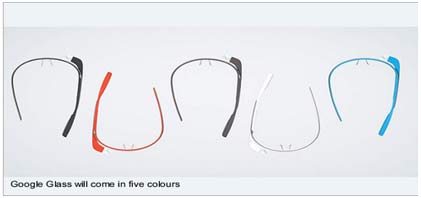
Fig. 4: Colors Available in Google Glass
Uses of Google Glass
Where and how can it Be Used?
Google glass is a device which can find use in a lot of fields. To find the uses of google glass would itself be an operational research project. Thanks to the open source nature of android (basically programming through Java), it allows third party developers to make their own applications which broadens the scope of innovation.
For personal use, it can be used as a great tool for travel, business, social networking and amateur photography. Of course, all of this can be done on a smart phone, so why google glass? One answer would be that, you need not concentrate only on the device while operating it. It is completely hands free, allowing the user to enjoy the privilege of operating it on the go. You see a memorablemoment which you wish to capture, but the moment has already passed by the time you remove your camera or smartphone, but if you have the google glass the moment is captured with a simple three words. You can capture memories as you see them, much like saving your memories on a hard disk. This is only a small part of the wide area of applications, like flight reminders, Evernote, google search on-the-go, assisted navigation, language translation, and many more.
In the industry google glass can be used to increase productivity. A workers performance can be recorded and reviewed to study areas of improvement or to maintain a database. Technicians can be provided guided instructions or to identify faults in a system. A small solar installing company in USA, “Sullivan Solar Power” has recognized the game changing power of google glass. They have organized brainstorming events to identify the range of application of glass to increase productivity. Programmers with no mobile app development experience were able to produce a workflow and an app in a couple of months testing it on a unit which was bought off EBay (global e-commerce website).
Healthcare applications of this device increase the efficiency of surgeries greatly. This was first studied by LuceinEngelen, a European healthcare professional who was invited into the explorer program by google. He conducted research on glass in operating theatres, ambulances,trauma helicopters, home care, and as an aid to teach students via video interactions (telephonic-consultation) on google hangouts. Recently in India in January 2014, a US based orthopedic surgeon, Dr. Selen G. Parekh conducted a foot and anklesurgery wearing the google glass. This operation was telecasted live on google during a national Indo-US conference. It was claimed that it was helpful to look the patient’s X-Ray or MRI (Magnetic Resonance Image) without taking the eye off the patient. The video recorded can provide an efficient aid in teaching students and practitioners alike.
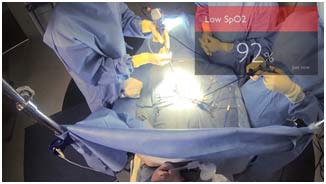
Fig. 5: Image Showing Use of Google Glass in Medical Field
Where is it Headed?
This is a technology which is beyond its time. It has sparked a revolution in the public, raising certain privacy and legal concerns. People do not like the idea of having a private conservation with the knowledge that there is an additional eye in the picture. Google glass is already banned in certain places containing sensitive business information. For the users, security is a major concern if the device is stolen, which may lead to piracy of private information. Google is working on security measures to deactivate a stolen device via an online interface. All in all, it will take a few years for this new market to settle in.
Google X which is barely out of the box with Google glass is already working on Google Glass 2 and another device which is rumored to the same capability on a contact lens via nanotechnology. Google faces tough competition from its rivals, apple and Microsoft who are working on similar products. Samsung are also rumored to be working on a more trendy and affordable version of the glass. In the end, leaders, Google Inc., have big plans for google glass as a mass consumer product on the turn of the decade.
The Consumer version of Glass will soon be available in google stores later this year (around May, 2014) at a lower price and with possible lens fixture provisions.
You may also like:

Filed Under: Applications, AR/VR, Articles, Tech Articles
Questions related to this article?
👉Ask and discuss on EDAboard.com and Electro-Tech-Online.com forums.
Tell Us What You Think!!
You must be logged in to post a comment.