Engineers Garage

  • Electronic Projects & Tutorials
    • Electronic Projects
      • Arduino Projects
      • AVR
      • Raspberry pi
      • ESP8266
      • BeagleBone
      • 8051 Microcontroller
      • ARM
      • PIC Microcontroller
      • STM32
    • Tutorials
      • Audio Electronics
      • Battery Management
      • Brainwave
      • Electric Vehicles
      • EMI/EMC/RFI
      • Hardware Filters
      • IoT tutorials
      • Power Tutorials
      • Python
      • Sensors
      • USB
      • VHDL
    • Circuit Design
    • Project Videos
    • Components
  • Articles
    • Tech Articles
    • Insight
    • Invention Stories
    • How to
    • What Is
  • News
    • Electronic Product News
    • Business News
    • Company/Start-up News
    • DIY Reviews
    • Guest Post
  • Forums
    • EDABoard.com
    • Electro-Tech-Online
    • EG Forum Archive
  • DigiKey Store
    • Cables, Wires
    • Connectors, Interconnect
    • Discrete
    • Electromechanical
    • Embedded Computers
    • Enclosures, Hardware, Office
    • Integrated Circuits (ICs)
    • Isolators
    • LED/Optoelectronics
    • Passive
    • Power, Circuit Protection
    • Programmers
    • RF, Wireless
    • Semiconductors
    • Sensors, Transducers
    • Test Products
    • Tools
  • Learn
    • eBooks/Tech Tips
    • Design Guides
    • Learning Center
    • Tech Toolboxes
    • Webinars & Digital Events
  • Resources
    • Digital Issues
    • EE Training Days
    • LEAP Awards
    • Podcasts
    • Webinars / Digital Events
    • White Papers
    • Engineering Diversity & Inclusion
    • DesignFast
  • Guest Post Guidelines
  • Advertise
  • Subscribe

Android Phone Controlled Robot using Arduino

By Deepesh Verma January 9, 2022

The Android phone that stays in your hand most of the time is useful in many other applications apart from Whatsapp, Facebook; appliances; and monitoring your health parameters.  What if it  could control a Robot to assist in your daily work? Yes, it’s possible! With this project you can make a robot that can be controlled by an Android  phone, over Bluetooth  communication.
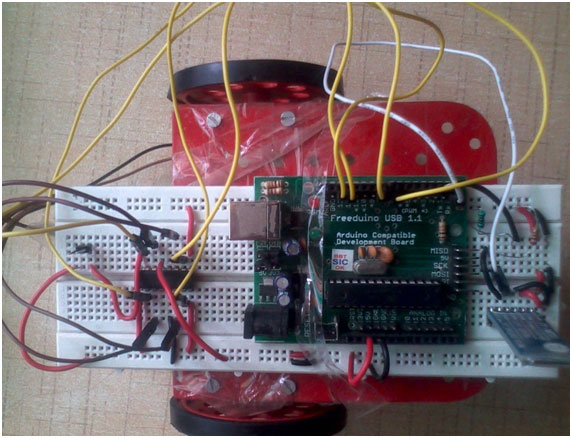
Prototype of Mobile operated Arduino Robot

Fig. 1: Prototype of Mobile operated Arduino Robot

The robot is built around Arduino interfaced with a Bluetooth receiver to receive commands from Android Phone.

The basic Block diagram of the system is as follows:
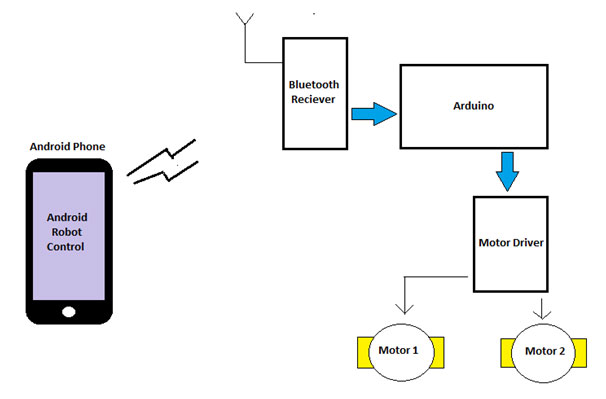
Block Diagram of Mobile operated Arduino Robot

Fig. 2: Block Diagram of Mobile operated Arduino Robot

Bluetooth Communication

Bluetooth is a wireless technology standard for exchanging data over short distances (using short-wavelength UHF radio waves in the ISM band from 2.4 to 2.485 GHz) from fixed and mobile devices, and building personal area networks (PANs). Invented by telecom vendor Ericsson in 1994, it was originally conceived as a wireless alternative to RS-232 data cables. It can connect several devices, overcoming problems of synchronization.

HC-05 module is an easy to use Bluetooth SPP (Serial Port Protocol) module, designed for transparent wireless serial connection setup. HC-05 is 6-pin Module. The module has 6 pins labelled on the back, but most modules only have 4 of those populated with pogo pins.  KEY & STATE seem to be not required, as KEY is used for flashing the device and STATE simply indicates if the device is awake or not.  So that leaves only GND, VCC, TXD, RXD.
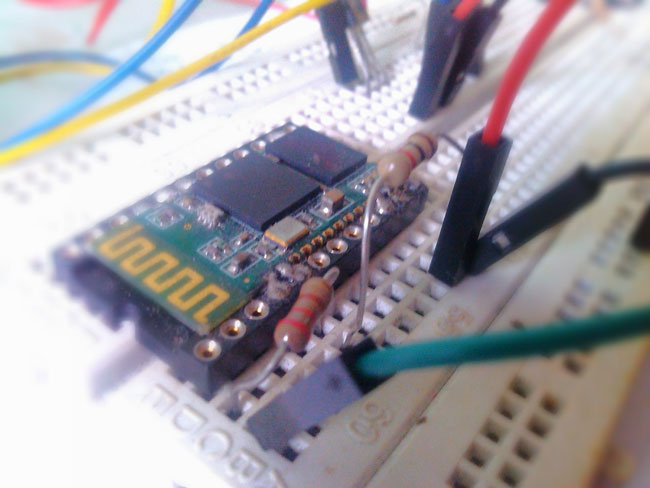
Image of HC-05 Bluetooth Module

Fig. 3: Image of HC-05 Bluetooth Module

For connecting The Module with Arduino, we need to use the Serial (Tx and Rx) pins provided on the board.

Connections with HC-04

Making Connections with HC-05:

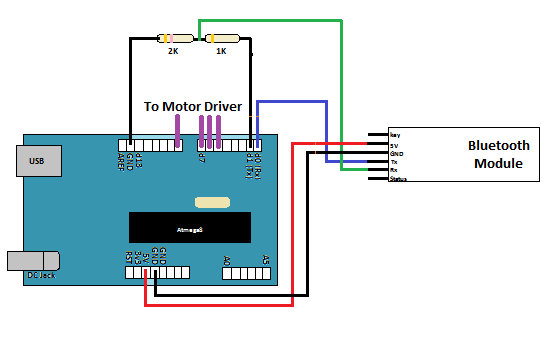
Some modules have VCC labelled for working voltages up to ~6 volts and DO NOT like anything except 3.3 volts on the VCC line. We should use a level converter to 3.3V on the RXD line.  Use two resistors, as a simple voltage divider to make the TTL level conversion.  One 2.2k ohm resistor to ground, connected to a 1k ohm resistor, to the TXD line on the MCU.
Connect the RXD pin in between the two resistors for an output of approx 3.4 volts.

Connect RXD pin of module to TXD of Arduino (Digital Pin 1), through the voltage divider configuration shown below:
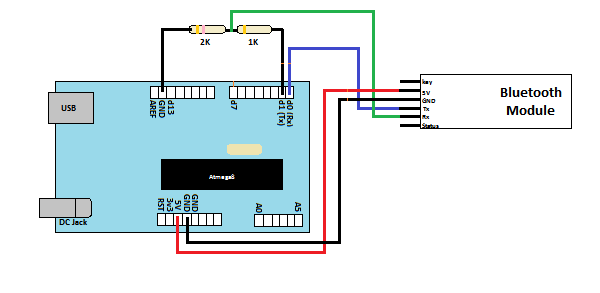
Circuit Diagram of Arduino and HC-05 Bluetooth Module Interfacing

Fig. 4: Circuit Diagram of Arduino and HC-05 Bluetooth Module Interfacing

Now connect TXD of module to RXD of Arduino (Digital Pin 0).

Android Application to Control Robot
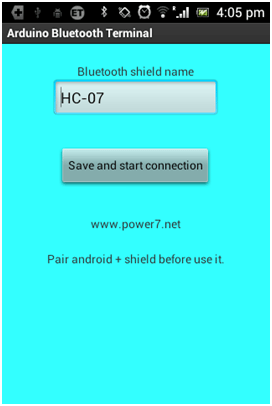
There are many applications on the play store for Arduino control over Bluetooth which are available for free. To keep the code simple, we’ll use “Arduino Bluetooth Terminal”.
Download and Install the same, and pair the Bluetooth Receiver to mobile.
A screen-shot of the App is given below:

Screenshot of Android App showing Bluetooth Connection with the Robot
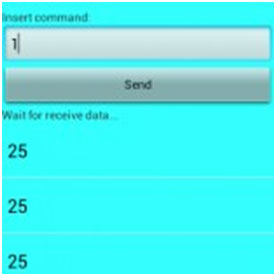
Fig. 5: 

Screenshot of Android App showing Bluetooth Connection with the Robot

Screenshot of Android App showing messages sent to the Arduino Robot

Fig. 6: Screenshot of Android App showing messages sent to the Arduino Robot

Motor Interfacing & Robot Assembly
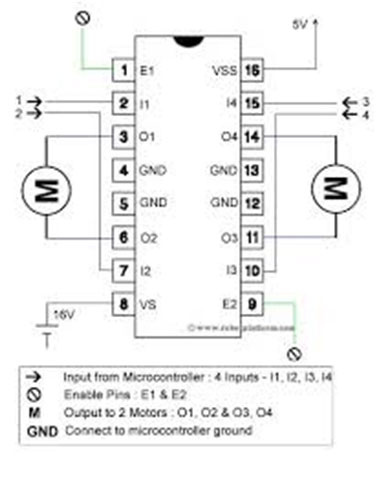
 

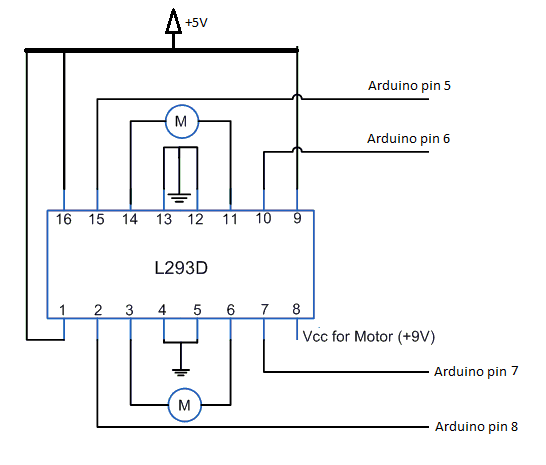
The motors are interfaced through Motor Driver (Dual H-Bridge type), commonly used version of it is L293D, which is available in 18 pin DIP.

Pin Diagram of L293D Motor Driver IC

Fig. 7: Pin Diagram of L293D Motor Driver IC

Robot assembly can be as shown below:
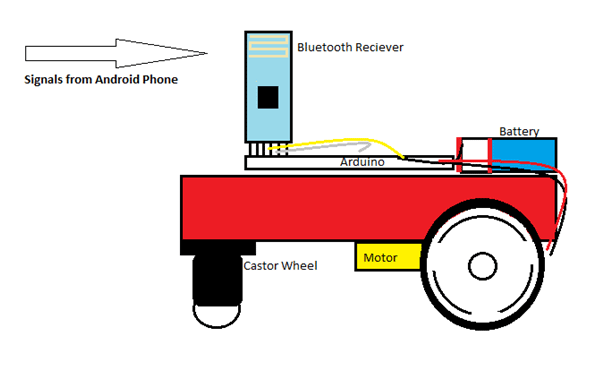
Image showing mechanical design of Arduino Robot

Fig. 8: Image showing mechanical design of Arduino Robot

Android mobile App to control the robot is available for free on the play store..

The motor driver inputs are connected to Arduino pins 5; 6; 7 and 8 respectively.
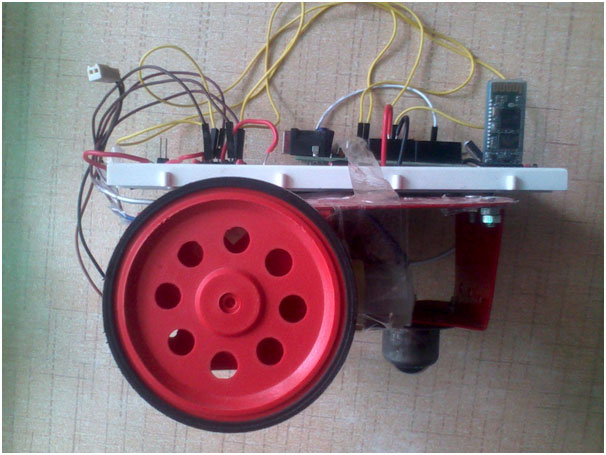
Image showing chassis and body of the Arduino Robot
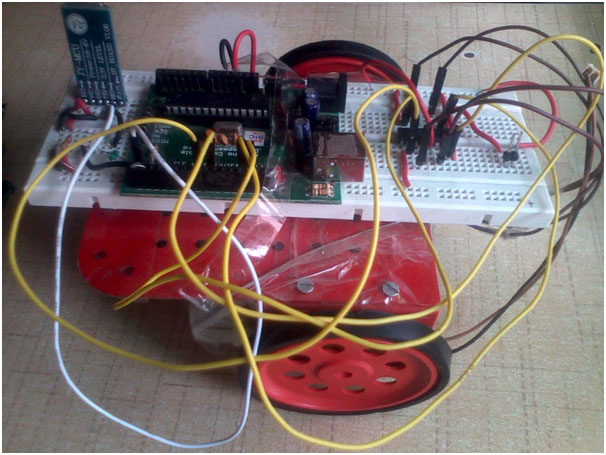
Fig. 9: Image showing chassis and body of the Arduino Robot

Image of Arduino Robot controlled by Android Phone

Fig. 10: Image of Arduino Robot controlled by Android Phone

You may also like:

  • What are the top development boards for AI and ML?

  • What are different types of industrial robots?

  • What are LoRa gateways and what types are available?

  • What battery chemistries are used in electric vehicles?

  • What are the different types of EV charging connectors?

  • What are the components of robotic arms and industrial robots?

Project Source Code

###


// Android Phone Controlled Robot
// Successfully Tested on Android App --> 'Arduino Bluetooth 
// Terminal'; it is available free on the Google Play Store
int state;
int flag=0;       
void stp();
void fwd();
void left();
void right();
void back();
void setup()
{
    pinMode(7,OUTPUT);                  
    pinMode(8,OUTPUT);                  
    pinMode(5,OUTPUT);                  
    pinMode(6,OUTPUT);                  
Serial.begin(9600);                                         // Baud rate set to 9600bps
}
void loop() {
    if(Serial.available() > 0)      // Ckeck for command Recieved
    {    
      state = Serial.read();
      Serial.println(state);  
      flag=0;
    }  
    if (state == '1')     // Checking Command from User
    {
        stp();
        if(flag == 0){
          Serial.println("Stop");
          flag=1;
       }
    }
    else if (state == '2')
    {
        fwd();
        if(flag == 0)
        {
          Serial.println("Forward");
          flag=1;
         }
    }
    else if (state == '3')
    {
        back();
        if(flag == 0)
        {
          Serial.println("Backward");
          flag=1;
        }
    }
    else if (state == '4')
    {
        left();
        if(flag == 0)
        {
          Serial.println("Left");
          flag=1;
         }
    }
   else if (state == '5')
  {
        right();
        if(flag == 0)
        {
          Serial.println("Right");
          flag=1;
         }
    }
}                                           //loop() ends here
void fwd()          // Forward
{
  digitalWrite(7,HIGH);
  digitalWrite(5,HIGH);
  digitalWrite(6,LOW);
  digitalWrite(8,LOW);
}
void back()          // Backward
{
  digitalWrite(8,HIGH);
  digitalWrite(6,HIGH);
  digitalWrite(7,LOW);
  digitalWrite(5,LOW);
}
void left()          //LEFT
{
  digitalWrite(7,HIGH);
  digitalWrite(5,LOW);
  digitalWrite(8,LOW);
  digitalWrite(6,LOW);
}
void right()          // Right
{
  digitalWrite(7,LOW);
  digitalWrite(5,HIGH);
  digitalWrite(8,LOW);
  digitalWrite(6,LOW);
}
void stp()            // Robot STops
{
  digitalWrite(7,LOW);
  digitalWrite(8,LOW);
  digitalWrite(5,LOW);
  digitalWrite(6,LOW);
}

###


Circuit Diagrams

Circuit-Diagram-L293D-Based-Motor-Driver-Arduino-Robot
Circuit-Diagram-Controller-Circuitry-Arduino-Robot


Filed Under: Electronic Projects
Tagged With: android, Arduino, Phone Controlled, robot
 

Next Article

← Previous Article
Next Article →

Questions related to this article?
👉Ask and discuss on Electro-Tech-Online.com and EDAboard.com forums.


Tell Us What You Think!! Cancel reply

You must be logged in to post a comment.

EE TECH TOOLBOX

“ee
Tech Toolbox: Internet of Things
Explore practical strategies for minimizing attack surfaces, managing memory efficiently, and securing firmware. Download now to ensure your IoT implementations remain secure, efficient, and future-ready.

EE Learning Center

EE Learning Center
“engineers
EXPAND YOUR KNOWLEDGE AND STAY CONNECTED
Get the latest info on technologies, tools and strategies for EE professionals.

HAVE A QUESTION?

Have a technical question about an article or other engineering questions? Check out our engineering forums EDABoard.com and Electro-Tech-Online.com where you can get those questions asked and answered by your peers!


RSS EDABOARD.com Discussions

  • Voltage mode pushpull is a nonsense SMPS?
  • Reducing "shoot-through" in offline Full Bridge SMPS?
  • High Side current sensing
  • How to simulate power electronics converter in PSpice?
  • Layout IRN reduction in Comparator

RSS Electro-Tech-Online.com Discussions

  • Back to the old BASIC days
  • Parts required for a personal project
  • PIC KIT 3 not able to program dsPIC
  • Failure of polypropylene motor-run capacitors
  • Siemens large industrial PLC parts

Featured – RPi Python Programming (27 Part)

  • RPi Python Programming 21: The SIM900A AT commands
  • RPi Python Programming 22: Calls & SMS using a SIM900A GSM-GPRS modem
  • RPi Python Programming 23: Interfacing a NEO-6MV2 GPS module with Raspberry Pi
  • RPi Python Programming 24: I2C explained
  • RPi Python Programming 25 – Synchronous serial communication in Raspberry Pi using I2C protocol
  • RPi Python Programming 26 – Interfacing ADXL345 accelerometer sensor with Raspberry Pi

Recent Articles

  • What is AWS IoT Core and when should you use it?
  • AC-DC power supply extends voltage range to 800 V DC
  • Infineon’s inductive sensor integrates coil system driver, signal conditioning circuits and DSP
  • Arm Cortex-M23 MCU delivers 87.5 µA/MHz active mode
  • STMicroelectronics releases automotive amplifiers with in-play open-load detection

EE ENGINEERING TRAINING DAYS

engineering

Submit a Guest Post

submit a guest post
Engineers Garage
  • Analog IC TIps
  • Connector Tips
  • Battery Power Tips
  • DesignFast
  • EDABoard Forums
  • EE World Online
  • Electro-Tech-Online Forums
  • EV Engineering
  • Microcontroller Tips
  • Power Electronic Tips
  • Sensor Tips
  • Test and Measurement Tips
  • 5G Technology World
  • Subscribe to our newsletter
  • About Us
  • Contact Us
  • Advertise

Copyright © 2025 WTWH Media LLC. All Rights Reserved. The material on this site may not be reproduced, distributed, transmitted, cached or otherwise used, except with the prior written permission of WTWH Media
Privacy Policy

Search Engineers Garage

  • Electronic Projects & Tutorials
    • Electronic Projects
      • Arduino Projects
      • AVR
      • Raspberry pi
      • ESP8266
      • BeagleBone
      • 8051 Microcontroller
      • ARM
      • PIC Microcontroller
      • STM32
    • Tutorials
      • Audio Electronics
      • Battery Management
      • Brainwave
      • Electric Vehicles
      • EMI/EMC/RFI
      • Hardware Filters
      • IoT tutorials
      • Power Tutorials
      • Python
      • Sensors
      • USB
      • VHDL
    • Circuit Design
    • Project Videos
    • Components
  • Articles
    • Tech Articles
    • Insight
    • Invention Stories
    • How to
    • What Is
  • News
    • Electronic Product News
    • Business News
    • Company/Start-up News
    • DIY Reviews
    • Guest Post
  • Forums
    • EDABoard.com
    • Electro-Tech-Online
    • EG Forum Archive
  • DigiKey Store
    • Cables, Wires
    • Connectors, Interconnect
    • Discrete
    • Electromechanical
    • Embedded Computers
    • Enclosures, Hardware, Office
    • Integrated Circuits (ICs)
    • Isolators
    • LED/Optoelectronics
    • Passive
    • Power, Circuit Protection
    • Programmers
    • RF, Wireless
    • Semiconductors
    • Sensors, Transducers
    • Test Products
    • Tools
  • Learn
    • eBooks/Tech Tips
    • Design Guides
    • Learning Center
    • Tech Toolboxes
    • Webinars & Digital Events
  • Resources
    • Digital Issues
    • EE Training Days
    • LEAP Awards
    • Podcasts
    • Webinars / Digital Events
    • White Papers
    • Engineering Diversity & Inclusion
    • DesignFast
  • Guest Post Guidelines
  • Advertise
  • Subscribe