Engineers Garage

  • Electronic Projects & Tutorials
    • Electronic Projects
      • Arduino Projects
      • AVR
      • Raspberry pi
      • ESP8266
      • BeagleBone
      • 8051 Microcontroller
      • ARM
      • PIC Microcontroller
      • STM32
    • Tutorials
      • Audio Electronics
      • Battery Management
      • Brainwave
      • Electric Vehicles
      • EMI/EMC/RFI
      • Hardware Filters
      • IoT tutorials
      • Power Tutorials
      • Python
      • Sensors
      • USB
      • VHDL
    • Circuit Design
    • Project Videos
    • Components
  • Articles
    • Tech Articles
    • Insight
    • Invention Stories
    • How to
    • What Is
  • News
    • Electronic Product News
    • Business News
    • Company/Start-up News
    • DIY Reviews
    • Guest Post
  • Forums
    • EDABoard.com
    • Electro-Tech-Online
    • EG Forum Archive
  • DigiKey Store
    • Cables, Wires
    • Connectors, Interconnect
    • Discrete
    • Electromechanical
    • Embedded Computers
    • Enclosures, Hardware, Office
    • Integrated Circuits (ICs)
    • Isolators
    • LED/Optoelectronics
    • Passive
    • Power, Circuit Protection
    • Programmers
    • RF, Wireless
    • Semiconductors
    • Sensors, Transducers
    • Test Products
    • Tools
  • Learn
    • eBooks/Tech Tips
    • Design Guides
    • Learning Center
    • Tech Toolboxes
    • Webinars & Digital Events
  • Resources
    • Digital Issues
    • EE Training Days
    • LEAP Awards
    • Podcasts
    • Webinars / Digital Events
    • White Papers
    • Engineering Diversity & Inclusion
    • DesignFast
  • Guest Post Guidelines
  • Advertise
  • Subscribe

Microchip adds to its 8-bit PIC and AVR microcontroller family

By Michelle Froese May 16, 2022

With smartphones, autonomous vehicles, and 5G wireless connectivity dominating the landscape of embedded design in 2022, Microchip’s 8-bit PIC and AVR microcontroller (MCU) families are gaining market share.
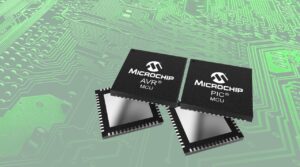
Over the past 50 years, the market for 8-bit MCUs has grown steadily and Microchip currently sells one device for every human in the western hemisphere each year.

To support this ongoing trend, Microchip Technology recently announced the release of five new product families and more than 60 new individual devices that offer embedded designers simple solutions to their most common problems.

Designers who are looking to create innovative designs are turning to Microchip’s new product families of PIC and AVR MCUs because of their processing power, ability to easily communicate with other chips, and analog peripherals that have been built to be configurable without having to make changes to the printed circuit board.

These devices combine ASIC-like capabilities with a simple development experience that extends traditional MCU capabilities and allows them to be configured as smart peripheral chips. Smart peripherals, like the software-controlled op amp found on the PIC16F171 family, the Multi-Voltage I/O (MVIO) and Analog-to-Digital Converter with Computation (ADCC) add value to applications that otherwise would not use traditional MCUs.

The challenge of spanning multiple voltage domains is a common situation in systems that include chips using different supply voltages (e.g., connecting a 5V MCU to a 1.8V sensor). This type of system would normally require level-shifting hardware, which increases costs. The MVIO peripheral found on Microchip’s latest 8-bit MCUs, including the AVR DD family, allows a single port on the MCU to operate in a different voltage domain than the rest of the MCU, which eliminates the need for additional external components.

Some systems require a level of speed and response time that is difficult to achieve with software-based processing. The Core Independent Peripherals (CIPs) available across the Microchip PIC and AVR product range can be programmed with MPLAB Code Configurator (MCC) to be easily connected to form a hardware processing chain. This makes it possible to create custom peripherals that eliminate software processing cycle times.

For example, a WS2812 LED array, which requires unique timing to be driven correctly, can be controlled easily by configuring a super peripheral consisting of a pulse-width modulator, an SPI interface, and the configurable logic cell (CLC).

As the market for 8-bit PIC and AVR MCU devices continues to grow, Microchip remains responsive to its customers’ long-term needs by adhering to strong fundamentals in their product portfolio and support structure. PIC and AVR MCUs are easy to design with and their support network enables Microchip’s customers to accelerate their time to revenue.

The 8-bit MCU portfolio is pin-to-pin compatible, which allows an alternate PIC or AVR MCU to be selected when more performance is needed or when a customer wants to maximize product availability while minimizing redesign requirements.

“PIC and AVR microcontrollers are incredibly popular because they are designed to meet our clients’ requirements for current, as well as future, applications,” said Greg Robinson, VP of marketing for Microchip’s 8-bit MCU business unit. “We have also built a robust supply chain for 8-bit PIC and AVR MCUs­, the vast majority of which are manufactured in Microchip-owned facilities. This allows us to control the production process in ways that are not common in the industry.”

Development tools
Microchip offers a full development ecosystem of hardware and software tools, including its MPLAB X and MPLAB Xpress Integrated Development Environments (IDEs) and MPLAB Code Configurator (MCC), which offers an intuitive graphical interface to generate production-ready setup and application code for 8-bit MCU-based projects.


Filed Under: AVR, Components, News, PIC Microcontroller
Tagged With: avr, chips, configurable, mcu, microchiptechnology, microcontroller, mplab, pic, smartperipherals
 

Next Article

← Previous Article
Next Article →

Questions related to this article?
👉Ask and discuss on EDAboard.com and Electro-Tech-Online.com forums.


Tell Us What You Think!! Cancel reply

You must be logged in to post a comment.

EE TECH TOOLBOX

“ee
Tech Toolbox: Internet of Things
Explore practical strategies for minimizing attack surfaces, managing memory efficiently, and securing firmware. Download now to ensure your IoT implementations remain secure, efficient, and future-ready.

EE Learning Center

EE Learning Center
“engineers
EXPAND YOUR KNOWLEDGE AND STAY CONNECTED
Get the latest info on technologies, tools and strategies for EE professionals.

HAVE A QUESTION?

Have a technical question about an article or other engineering questions? Check out our engineering forums EDABoard.com and Electro-Tech-Online.com where you can get those questions asked and answered by your peers!


RSS EDABOARD.com Discussions

  • Reducing "shoot-through" in offline Full Bridge SMPS?
  • High Side current sensing
  • How to simulate power electronics converter in PSpice?
  • Voltage mode pushpull is a nonsense SMPS?
  • Layout IRN reduction in Comparator

RSS Electro-Tech-Online.com Discussions

  • Back to the old BASIC days
  • Parts required for a personal project
  • PIC KIT 3 not able to program dsPIC
  • Failure of polypropylene motor-run capacitors
  • Siemens large industrial PLC parts

Featured – RPi Python Programming (27 Part)

  • RPi Python Programming 21: The SIM900A AT commands
  • RPi Python Programming 22: Calls & SMS using a SIM900A GSM-GPRS modem
  • RPi Python Programming 23: Interfacing a NEO-6MV2 GPS module with Raspberry Pi
  • RPi Python Programming 24: I2C explained
  • RPi Python Programming 25 – Synchronous serial communication in Raspberry Pi using I2C protocol
  • RPi Python Programming 26 – Interfacing ADXL345 accelerometer sensor with Raspberry Pi

Recent Articles

  • What is AWS IoT Core and when should you use it?
  • AC-DC power supply extends voltage range to 800 V DC
  • Infineon’s inductive sensor integrates coil system driver, signal conditioning circuits and DSP
  • Arm Cortex-M23 MCU delivers 87.5 µA/MHz active mode
  • STMicroelectronics releases automotive amplifiers with in-play open-load detection

EE ENGINEERING TRAINING DAYS

engineering

Submit a Guest Post

submit a guest post
Engineers Garage
  • Analog IC TIps
  • Connector Tips
  • Battery Power Tips
  • DesignFast
  • EDABoard Forums
  • EE World Online
  • Electro-Tech-Online Forums
  • EV Engineering
  • Microcontroller Tips
  • Power Electronic Tips
  • Sensor Tips
  • Test and Measurement Tips
  • 5G Technology World
  • Subscribe to our newsletter
  • About Us
  • Contact Us
  • Advertise

Copyright © 2025 WTWH Media LLC. All Rights Reserved. The material on this site may not be reproduced, distributed, transmitted, cached or otherwise used, except with the prior written permission of WTWH Media
Privacy Policy

Search Engineers Garage

  • Electronic Projects & Tutorials
    • Electronic Projects
      • Arduino Projects
      • AVR
      • Raspberry pi
      • ESP8266
      • BeagleBone
      • 8051 Microcontroller
      • ARM
      • PIC Microcontroller
      • STM32
    • Tutorials
      • Audio Electronics
      • Battery Management
      • Brainwave
      • Electric Vehicles
      • EMI/EMC/RFI
      • Hardware Filters
      • IoT tutorials
      • Power Tutorials
      • Python
      • Sensors
      • USB
      • VHDL
    • Circuit Design
    • Project Videos
    • Components
  • Articles
    • Tech Articles
    • Insight
    • Invention Stories
    • How to
    • What Is
  • News
    • Electronic Product News
    • Business News
    • Company/Start-up News
    • DIY Reviews
    • Guest Post
  • Forums
    • EDABoard.com
    • Electro-Tech-Online
    • EG Forum Archive
  • DigiKey Store
    • Cables, Wires
    • Connectors, Interconnect
    • Discrete
    • Electromechanical
    • Embedded Computers
    • Enclosures, Hardware, Office
    • Integrated Circuits (ICs)
    • Isolators
    • LED/Optoelectronics
    • Passive
    • Power, Circuit Protection
    • Programmers
    • RF, Wireless
    • Semiconductors
    • Sensors, Transducers
    • Test Products
    • Tools
  • Learn
    • eBooks/Tech Tips
    • Design Guides
    • Learning Center
    • Tech Toolboxes
    • Webinars & Digital Events
  • Resources
    • Digital Issues
    • EE Training Days
    • LEAP Awards
    • Podcasts
    • Webinars / Digital Events
    • White Papers
    • Engineering Diversity & Inclusion
    • DesignFast
  • Guest Post Guidelines
  • Advertise
  • Subscribe